Why “40 settings” is the wrong thing to shop for
Grinder marketing counts settings. Espresso cares where those settings are.
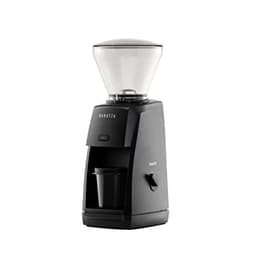
Compare two grinders from the same manufacturer, using only the manufacturer’s own published copy. Baratza says the standard Encore’s 40 individual grind settings “can take you from cold brew coarse to espresso fine with just a twist of the hopper”. Baratza says the Encore ESP’s settings are split, with “#1-20 will get you high-resolution espresso grinds and #21-40 is ready to grind for filter, french press, or cold brew”. Same number of settings. Half of the ESP’s dial is dedicated to the fine end, so the gap between one espresso setting and the next is far smaller.
That gap is the whole thing. Dialling in a shot means nudging the grind until the shot runs in roughly the right time at roughly the right ratio — the NCA’s figures are 1:2 dry coffee to liquid espresso over 20 to 30 seconds. If every click moves the shot time by fifteen seconds, you cannot land on it; you oscillate either side of it forever and conclude the machine is bad. This is the most common reason a gifted espresso machine ends up unused, and it is a grinder problem the whole way down.
What to look for in an espresso grinder
- Conical or flat burrs, never blades. A blade grinder chops at random and produces a mix of dust and boulders, and the dust is what turns a shot bitter. Burr vs blade covers why in full. Every pick on this page is a burr grinder.
- Fine adjustment, and a way to count your way back. External numbered clicks on a hand grinder, or a stepped dial you can read on an electric one. If changing the setting means disassembling the grinder, or if the adjustment has no markings, nobody will experiment — and experimenting is the job.
- Low retention, or at least a design you can empty. Coffee left inside the grinder from yesterday gets dosed into today’s shot. Hand grinders win here almost by accident: the grounds chamber comes off.
- Serviceable parts. Burrs are consumables on a long enough timeline. Baratza’s platform is the best-known example — the company says the Encore’s components are “designed to last around 10 years of home use” and the ESP uses a quick-release burr for cleaning.
- Effort, honestly assessed. A hand grinder is genuinely pleasant for one shot a day and genuinely miserable for four. Espresso doses are small, which helps, but espresso grind is fine, which is where the resistance comes from. Manual vs electric is the longer version of that decision.
How the five compare
| Grinder | Type | Adjustment | Also good for |
|---|
| Baratza Encore ESP | Electric conical burr | 40 settings, #1–20 for espresso (Baratza) | Filter, French press, cold brew |
|---|
| KINGrinder K6 | Manual conical burr | External, numbered clicks | Espresso through French press |
|---|
| Timemore Chestnut C3 ESP | Manual, stainless conical | Stepped, espresso-capable | Espresso + filter, travel |
|---|
| 1Zpresso J Series | Manual, precision conical | Fast, fine, repeatable | Espresso-focused |
|---|
| Breville Barista Express | Machine with integrated grinder | 16 grind settings (Breville) | Espresso only — it is a machine |
|---|
One line of context for that last row. Breville publishes the Barista Express as “Grind, dose and extract all in one”, with an integrated conical burr grinder, 16 grind settings and a 54 mm portafilter it describes as taking “the ideal dose of 18g”. Sixteen settings is far fewer than a standalone grinder offers, but they are all pointed at espresso, and the machine and grinder were designed against each other. For someone who owns nothing yet, that is a better gift than a machine plus a grinder you have to match up yourself.
Two grinders not to buy for espresso
Both of these are good grinders. Neither belongs under an espresso machine, and both get bought for one every Christmas.
The Fellow Ode Gen 2. Fellow could not be clearer about this on its own product page: the Ode is “Designed for brewed coffee methods only, including AeroPress, pour over, electric coffee makers, French press, and cold brew” and “Ode is not intended for espresso.” It is a 64 mm flat-burr grinder with 11 settings and 31 total steps, which is a lovely specification for filter and the wrong tool here. If they brew pour-over, buy it happily — see best coffee grinders and Fellow Ode vs Baratza Encore.
The standard Baratza Encore. A deserved classic, and Baratza calls it “the top barista-recommended grinder to elevate your filter brew journey”. Its 40 settings span cold brew to espresso fine, which sounds like it covers espresso and in practice means the espresso range is a handful of clicks at the very bottom of the dial. If espresso is the point, the ESP version exists precisely because of that — Encore vs Encore ESP is the direct comparison, and our Encore review covers the original on its own terms.
What to buy with it
A grinder is the gift. These are the cheap things that make it land properly.
Fresh whole-bean espresso coffee, bought the same week. A grinder with a stale bag next to it is a wasted present. The NCA puts roasted whole beans at roughly one to three weeks of peak freshness at room temperature against one to two weeks for ground coffee — which is the entire argument for owning a grinder. Best espresso beans has the bags, and whole bean vs ground explains the trade honestly.
A scale that reads to 0.1 g. The NCA lists a scale alongside the machine and the grinder as espresso equipment, for the simple reason that dialing in means changing one variable at a time — impossible if the dose itself is wobbling. Do you need a coffee scale is the honest yes-or-no, and best coffee scales has the picks.
A tamper and a distribution tool, if they are past the basics. Grind resolution only shows up in the cup if the puck is level. Best espresso accessories covers the small kit, and gifts for espresso lovers is the wider gift list if you are not sure a grinder is the right call at all.
Last thing, and it is the mistake we see most in this category: do not buy a cheap electric grinder for espresso because it is electric. Between a cheap electric grinder and a good hand grinder at the same price, the hand grinder wins on espresso every time, because the money went into burrs and adjustment instead of a motor and a plastic housing. The honest reason to buy electric is volume — two or more drinks a day, or several people in the house. One person, one shot a morning, is exactly what a hand grinder is for.