Start with the water, not the brewer
Coffee is a hot-water problem before it is a coffee problem. Work out what heat source exists at the destination and the shortlist narrows to one or two picks immediately.
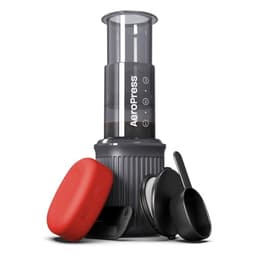
- There’s a kettle or a tap that gets hot: hotels, offices, holiday rentals, someone else’s kitchen. Any brewer here works, and the AeroPress Go or the Clever Dripper are the easiest. Both take paper, so the used grounds go in a bin rather than down a sink.
- There’s a gas or camp burner: the moka pot. It is the heat source’s brewer — no filters, no kettle, nothing to run out of. The 3-cup Moka Express is listed at about 4.3 oz (130 ml) of finished coffee, which is one strong mug’s worth rather than three mugs, so size it to the number of drinkers.
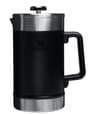
- There’s a fire or a stove and a group: the Stanley. Boil water in anything, pour it in, wait four minutes, plunge. It is vacuum-insulated stainless, so the second cup is still hot an hour later and nothing in it can break on a rock.
- There’s nothing but a USB socket: the OutIn Nano. OutIn states the heating blade takes 50 ml of cold water to 198°F in about three minutes, and the battery gives up to five brews from cold water or over 200 using hot water on a charge. That is the only pick here that needs no external heat at all.
- There’s hot water but they want espresso: the Wacaco Nanopresso, which is a hand pump — you supply hot water and the pressure comes from your palm.
The four things that separate a travel brewer from a small brewer
- Does it survive a bag? Glass is out, which rules out most of the brewers we recommend for a kitchen. Everything here is plastic, aluminium or stainless. The Stanley is the only pick that can be dropped on a campsite without consequences.
- Does it nest? The AeroPress Go is the clearest example of a brewer designed as luggage rather than shrunk down: the press, the filters and the stirrer pack inside the mug, and the mug’s lid is the lid. A brewer that travels as four loose parts travels badly.
- What happens to the grounds? Paper filter brewers (the AeroPress, the Clever Dripper) make a dry puck or a folded filter you drop in a bin. Mesh and moka brewers leave wet sludge, which is fine outdoors and awkward in a hotel.
- How does it get cleaned where they’re going? This is the one people forget. A French press needs a rinse and a shake-out; a moka pot needs to be dried properly or the aluminium stains; an electric portable needs a wipe and a charge. Nothing here needs a dishwasher, which is deliberate.
Grind before you go — or take the grinder
The honest weakness of every travel setup is the coffee, not the brewer. Ground coffee goes stale faster than beans: the National Coffee Association puts roasted whole beans at roughly one to three weeks at room temperature against one to two for ground, which is why a bag ground on Monday tastes flat by Thursday on a two-week trip.
For a trip of a few days, grinding at home and sealing the bag is completely fine and much simpler. For anything longer — or for someone who travels constantly — a hand grinder is the single best addition to any pick on this page. It needs no power, packs beside the brewer and solves the staleness problem outright. See best manual coffee grinders, and manual vs electric if they already own an electric one and you are wondering whether a second grinder is silly (it is not, for this reason).
Two grind notes specific to these brewers. The AeroPress and the Clever Dripper want a medium grind — the NCA’s comparison for drip is “like kosher salt” — and the French press wants it coarser, or the mesh lets dust through into the cup. The moka pot wants medium-coarse and, per Bialetti, the grounds must never be pressed down, which is the single most common moka mistake. Our coffee grind size guide has the whole scale, and how to use a moka pot covers the stovetop route step by step.
What to put in the box with it
A travel brewer is a gift that gets opened and then packed, so the add-ons that matter are the ones that make it usable on the first trip. For the AeroPress Go, a spare pack of filters — they are consumable and running out abroad is annoying. For the Stanley or the moka pot, a bag of beans and something to grind them with. For either portable espresso maker, a small tin of espresso-labelled coffee from best espresso beans.
And for anyone whose coffee happens on the move rather than in a room, an insulated mug does more for the experience than any upgrade to the brewer. Our best travel coffee mugs page covers that side; the AeroPress Go is the only pick here that ships with one built in.
One last piece of honesty: if the person you are buying for travels mostly to places with a decent cafe on the corner, the best travel coffee maker is none of these. This category is for people whose destinations do not have that — trailheads, job sites, conference hotels in business parks, long drives. If that is them, it is one of the most-used gifts on this site.