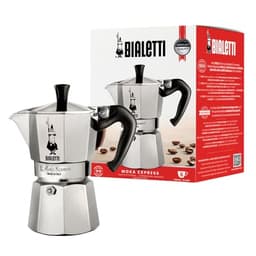
“6-cup” does not mean six mugs
This is the single most useful thing to know before you buy one, and it is the reason so many moka pots end up unused. The cup numbers on a moka pot are espresso servings, not mugs. Bialetti states it plainly: moka sizing “is based on espresso servings (≈2 oz each), not mugs”, and publishes the volumes to match — its 2-cup Brikka holds 3.3 oz and the 4-cup holds 5.7 oz.
So a “6-cup” Moka Express is not six breakfast mugs of coffee. It is roughly two small strong cups, or the base for two milky drinks. A “3-cup” is one good cup. Read the numbers that way and the size choice becomes obvious:
| Marked size | What it actually makes | Buy it for |
|---|
| 1–2 cup | One short, very strong cup | An espresso-style drinker who wants one shot, or a desk pot |
|---|
| 3 cup | One full cup, or one small latte | A single coffee drinker — the most common gift mistake to avoid |
|---|
| 4 cup | Two small cups | A couple who each have one |
|---|
| 6 cup | Two strong cups, or two milky drinks | A household, and the default gift size |
|---|
| 9–10 cup | Three to four cups in one brew | People who entertain, or a shared kitchen |
|---|
One warning that follows from the same fact: a moka pot is filled to its own line every time, so you cannot brew a small amount in a big pot. Half-filling a 6-cup does not give you a smaller coffee, it gives you a worse one. Buy the size that matches the number of cups they drink in one sitting, not the size that sounds generous.
Check their cooktop before you spend anything
The classic moka pots — the Moka Express, the Brikka, the Pulcina and most of the colorful ones — are aluminum. Aluminum is why they are light, cheap and quick to heat, and it is also why they do not work on induction: an induction cooktop heats magnetic metal, and aluminum is not magnetic. On a gas flame, a coil element or a flat electric or ceramic top, any of these pots is fine.
There are two honest ways around an induction kitchen, and it is worth knowing both before you buy the wrong thing. The first is a steel pot: Bialetti builds the Venus in 18/10 stainless steel and lists it as compatible with electric, gas and induction cooktops, with a boiler wall 20% thicker than its standard pots. That is the pick above for an induction kitchen, and it is the simplest answer. The second is an adapter plate — a steel disc that sits between the cooktop and the pot. Bialetti itself says the Brikka “works on gas, electric, and camping stoves” and that induction use means pairing it with “Bialetti’s adapter plate (sold separately)”. An adapter works, but as a gift it means handing someone an accessory they have to buy or be given as well, which is exactly the kind of small friction that leaves a present in its box.
If you do not know what kind of stove they have and cannot ask without ruining the surprise, two things are safe: the stainless Venus, which covers every cooktop, or a gift that does not care about stoves at all — a French press or a pour-over set only needs hot water.
Is moka coffee actually espresso?
No, and it is worth being straight about this because the boxes say “stovetop espresso maker”. Espresso is defined by pressure: the National Coffee Association describes it as nearly boiling water forced through a fine grind under high pressure, drawn in 20 to 30 seconds, with crema as “the velvety, golden-brown top layer”. A moka pot works by steam pressure from the bottom chamber pushing water up through the coffee, at a fraction of the pressure a real machine makes.
What you get is its own thing: a small, dark, heavy, intense cup that is stronger than drip and softer than a true shot, with no crema on top. Plenty of people prefer it, and it is the everyday coffee of millions of Italian kitchens. But if the person you are buying for specifically wants espresso with crema, a cappuccino they froth themselves, or anything a cafe would call a shot, a moka pot is the wrong gift and a beginner espresso machine is the right one. The exception on this list is the Brikka, which exists precisely to close that gap: Bialetti says it uses “patented pressure technology and a silicone valve” to hold pressure back until it can push out a genuine crema layer.
The grind is the one thing they can get wrong
A moka pot takes a grind between drip and espresso — finer than a filter machine, coarser than a real espresso basket. Too coarse and the coffee comes out thin and sour; too fine and the pot struggles, hisses and pushes out something bitter. There is no dial to adjust, so the grind is the whole adjustment.
That has two consequences for a gift. If they buy pre-ground coffee, an espresso grind is generally the closer match than a drip grind, and many bags labeled for moka or espresso are ground about right. If they grind their own, this is a brewer that rewards a burr grinder and punishes a blade one, because an even grind is what stops the pot from channeling water through one soft spot. Our coffee grind size guide shows the range, burr vs blade explains why the mechanism matters more than the price, and best coffee grinders has the picks if you want to give the pair together.
What to put in the box with it
A moka pot is a small gift, so it is one of the easiest things on this site to turn into a proper present without spending much more. Three combinations that work, in order of how reliably they land:
- Pot plus a bag of dark-roast coffee.The classic pairing, and the one that needs nothing else. A dark, chocolatey roast suits the strong, low-acid cup a moka pot makes — best espresso beans covers bags that fit it, and any of them can be bought pre-ground.
- Pot plus small cups. A moka pot pours two-ounce servings, and drinking those out of a big mug feels wrong. Small, thick-walled cups make the ritual; best coffee mugs has sets, including the double-walled glasses that suit a short black coffee.
- Pot plus a hand grinder.The upgrade for someone who is already into coffee rather than new to it. It doubles the cost of the gift and roughly doubles what the pot can do — best manual coffee grinders starts under $50.
Living with one, honestly
Two things to set expectations. First, care: these are hand-wash objects. The stainless Venus is the clearest case, because Bialetti publishes that it is “not dishwasher safe”, and the aluminum pots are treated the same way by most owners, who rinse and dry them rather than putting them through a cycle. A moka pot has a rubber gasket and a safety valve that both want to stay clean, and neither wants detergent baked onto it.
Second, parts. The gasket and filter plate are consumables, and they are sold as spares for the mainstream pots, which is a quiet argument for buying a pot from a brand that still sells parts for it: a $50 pot that can be re-gasketed for a few dollars is a ten-year object, and an unbranded one usually is not. That, plus the size and the metal, is the whole buying decision.