Turkish coffee is the one brewing method on this site that needs no electricity, no filter, no paper and no pump — a small long-handled pot, a flame and coffee ground to a powder. It is also the method with the shortest list of things to get right, and the shortest window in which to get them right: everything hinges on a grind finer than espresso and on lifting the pot off the heat before it boils.
It matters culturally in a way that very little coffee equipment does. UNESCO added Turkish coffee culture and tradition to its Representative List of the Intangible Cultural Heritage of Humanity, and its description of the method is short enough to quote in full in a paragraph: the freshly roasted beans are ground to a fine powder, the ground coffee, cold water and sugar go into a coffee pot together, and it is brewed slowly on a stove to produce the desired foam. Every instruction below is detail around those three clauses.
As a gift, this is the method to give someone who already owns every normal brewer. A copper cezve costs less than a decent gooseneck kettle, looks like an object rather than an appliance, and makes a drink none of their other gear can.
What you need
- A cezve (also sold as an ibrik or a briki) — a small pot, wide at the base and narrow at the neck, with a long handle. The narrow neck is not decoration: it concentrates the foam.
- Extra-fine ground coffee. Finer than espresso, closer to powdered sugar than to sand. This is the part people underestimate, and the reason the practical answer is to buy it already ground — see below.
- Small cups — about 80 ml each. Espresso cups work.
- A heat source you can turn down low. Gas is easiest. An electric coil works. Copper is not magnetic, so a copper cezve will not work on an induction cooktop, and neither of the pots on this page claims to.
- No scale, no filter, no timer. You judge this one by eye.
The grind, which is the whole difficulty
Turkish coffee is brewed by suspension: the grounds never leave the water, so they have to be fine enough to give up their flavor in a few minutes and then settle out in the cup. Espresso grind is too coarse for that, and most home grinders — including every hand grinder we recommend on the manual grinder page — publish espresso as their finest setting rather than anything below it. Traditional Turkish mills exist precisely because ordinary burr grinders stop short.
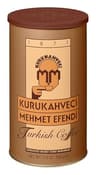
So the honest advice is the unfashionable one: buy it pre-ground, from a roaster that grinds for the method. The Istanbul house brand below states “extra fine grind for cezve and ibrik” on its own label, which is the only grind claim on this page we are willing to make. Everything we say about grind size elsewhere — in the grind size guide — puts Turkish at the fine end of the scale, past espresso, and that is a place home equipment generally cannot reach.
The method, step by step
1. Measure with the cup you will drink from
Fill the cezve using the small cup itself: one cup of cold water per serving. Turkish coffee cups are tiny — the set on this page is 80 ml a cup — and the pot should end up no more than two-thirds full so the foam has room to climb. Cold water, not hot: UNESCO's own description of the tradition has the ground coffee, cold water and sugar going into the pot together at the start.
2. Add the coffee — and the sugar now, not later
Roughly one heaped teaspoon of extra-fine coffee per cup, which is approximate rather than official; there is no single published figure, so treat it as a starting point and adjust. Sugar goes in at this stage if they take it, because you cannot stir a finished cup without destroying the foam and stirring up the grounds. Sweet, medium or none is a decision made before the heat goes on.
3. Stir once, cold, then stop touching it
Stir the powder into the cold water until there are no dry lumps. This is the only stir in the whole process. Once the pot is on the heat, a spoon will knock down the foam you are about to spend four minutes building.
4. Low heat. Slower than you think
UNESCO describes the coffee as “brewed slowly on a stove to produce the desired foam”, and slowly is the operative word — three to four minutes, not sixty seconds. On a copper cezve the metal does the work; the pot is thin and conducts fast, which is exactly why the flame should be small.
5. Watch for the foam to rise, and lift the pot before it boils over
A dark ring of foam forms at the edge and creeps inward, then the surface domes and starts to climb the neck. That is the moment: lift the cezve off the heat. If it boils, the foam collapses and does not come back, and the coffee turns bitter and flat.
6. Share the foam between the cups, then return the pot to the heat
Spoon or pour a little foam into each cup first, so nobody gets a cup without it — the foam is the mark of a cup made properly. Put the pot back on the low flame for a few seconds until it rises a second time, then pour the rest.
7. Let it settle for a minute, and serve water alongside
The grounds are in the cup; nothing filters them out. A minute standing still drops them to the bottom as a thick sludge you do not drink. UNESCO's description has the drink “served in small cups, accompanied by a glass of water” — the water resets the palate before the first sip, and it is part of the ritual rather than an afterthought.
Four minutes, start to finish, and two of the seven steps are the ones that decide the cup: sugar in at the beginning, and the pot off the heat at the foam rather than at the boil.
The four things that go wrong
No foam
Either the heat was too high or the pot boiled. Foam builds slowly and collapses instantly; once it has gone it does not return, and there is no saving that pot. Turn the flame down further than feels reasonable and try again.
Bitter, ashy coffee
It boiled. Boiling is the one irreversible mistake in this method — the same mistake that makes a moka pot taste scorched when it is left on the heat, and for the same reason: the brew keeps cooking as long as it is over a flame.
Weak, thin coffee
Almost always the grind. If the coffee was ground for espresso or, worse, for drip, the water passes through it without extracting much in the few minutes available. The second cause is too much water for the amount of coffee, which is why measuring with the serving cup matters.
A mouthful of grit
It was poured and drunk too fast. Let the cup stand for a minute; the powder drops. And stop drinking at the point the liquid turns opaque — the last centimeter is sediment, not coffee, and it is meant to stay in the cup.
Turkish coffee is not espresso
Both are small, dark and strong, and that is where the similarity stops. Espresso is defined by pressure — nearly boiling water forced through a compacted bed of fine coffee in seconds, which is what builds crema. Turkish coffee has no pressure at all: it is a slow simmer with the grounds left in, and its foam is foam, not crema. If the person you are buying for wants espresso, the gift is a machine — the beginner espresso machines page is the right place to start, and what is espresso explains the distinction properly.
What to buy
Four things, and you need at most three of them: a pot, the right coffee, and cups if the gift is meant to look like an occasion. Every price below is live from Amazon on the date stamped under the button.