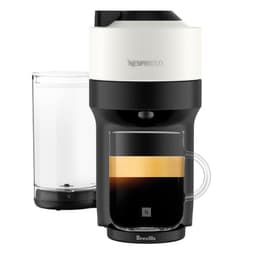
Side by side
Every row below is a real, practical difference rather than a marketing claim. The figures come from the manufacturers’ own published pages, cited at the bottom.
| | Nespresso (capsule) | Espresso machine |
|---|
| Skill needed | None. Insert capsule, press button. | Real. Grind, dose, tamp, time the shot. |
|---|
| Time to first good cup | About a minute, out of the box | Days to weeks of dialling in |
|---|
| Consistency | Identical every time by design | As consistent as the person is |
|---|
| Also needs | Nothing | A grinder; ideally a scale and a pitcher |
|---|
| Coffee choice | The system's own capsule range | Any bag of beans, any roaster |
|---|
| Cost per drink | Fixed, and tied to one supplier | Lower per cup; higher up front |
|---|
| Waste | One capsule per drink to recycle | A puck of grounds (compostable) |
|---|
| Ceiling | Good, and it stops there | Cafe-level, if they put the work in |
|---|
| Counter space | Small; Pop+ is the smallest here | Machine plus grinder, side by side |
|---|
| Best gift for | Someone who wants the drink | Someone who wants the hobby |
|---|
The hidden cost on each side
Both routes have a cost that is not on the box, and they are opposite in shape.
Nespresso’s hidden cost is the capsules, forever. The machine is cheap because the capsules are the business. Worse for a gift buyer, it is a closed system in a specific way: Nespresso’s own range page states that Vertuo pods are compatible only with Vertuo machines. Buy a Vertuo and you have bought a lifetime of Vertuo pods. That is not a scandal — it is a reasonable trade for never having to think — but it means the cost per drink never falls, and it never gets cheaper by shopping around for coffee. Nespresso lists six Vertuo cup sizes, from a 40 ml espresso to a 535 ml carafe, so at least the machine covers more than one drink.
The espresso machine’s hidden cost is everything around it. A Bambino with no grinder is a machine fed pre-ground coffee, which wastes most of what you paid for. Breville gives 18 g as the Bambino’s ideal dose for its 54 mm basket, and hitting a repeatable 18 g of consistently fine grind is a burr grinder’s job — see best coffee grinders and burr vs blade. Budget the grinder into the gift from the start, or give the machine with a bag of beans and the grinder as the next birthday.
How to work out which one actually pays off
You can settle this with arithmetic rather than opinion, and it takes two minutes.
- Count their drinks per week. Honestly, not aspirationally — the number they drink now, from wherever they currently get coffee.
- Price a capsule drink. One capsule, plus milk if it is a milk drink. That number is fixed and does not improve.
- Price a machine drink. Divide the grams in a bag of beans by 18 to get the number of double shots in the bag, then divide the bag’s price by that. Add milk.
- Compare the up-front gap to the weekly gap. The machine route costs more at the start (machine plus grinder) and less per drink. Divide the extra up-front cost by the weekly saving and you have the number of weeks until it breaks even.
Two honest adjustments. Add a bag of beans for the dialling-in period, which goes down the sink. And treat the answer as a tiebreaker, not a reason: nobody has ever enjoyed a machine because it had a good payback period, and a setup that pays off on paper but never gets used saves nothing. Our is an espresso machine worth it guide runs the same question in more detail.
The three people this question usually gets asked about
- “They drink one coffee a day and are not interested in how it is made.” Nespresso, without hesitation, and the Vertuo Pop+ specifically. A real machine for this person is a gift that creates homework.
- “They drink lattes and cappuccinos, not espresso.” Still capsules, but the Lattissima One rather than the Pop+ — it pours fresh milk into the cup from a detachable, dishwasher-safe jug, so they get the actual drink they order rather than a shot they then have to do something about. The alternative, if you want a real machine, is a Bambino Plus with its automatic steam wand — see best espresso machines with a milk frother.
- “They have been talking about espresso for months.” A real machine. The Bambino if the budget allows, the De’Longhi Stilosa if you want to find out whether the enthusiasm survives contact with a tamper before anyone spends real money. The Stilosa is genuinely the low-risk answer here: it costs little enough that discovering the hobby is not for them is not an expensive mistake.
And the combination nobody suggests but plenty of households end up with: a capsule machine for weekday mornings and a moka pot or an AeroPress for the weekend, when there is time to enjoy making something. If you are buying for a household rather than a person, that is often the better two-gift plan than one expensive machine.