Burr or blade: the only spec that really sorts this category
Every machine on this page grinds beans. Only some of them grind beans well, and the word on the box that tells you which is burr. A burr grinder mills coffee between two abrasive surfaces set a fixed distance apart, so every particle comes out close to the same size. A blade grinder is a propeller in a cup: it smashes beans for as long as the motor runs, producing dust and boulders in the same batch. Our burr vs blade grinder guide has the full explanation, and it is worth two minutes before you spend anything here.
Why it matters in a drip machine specifically: water extracts coffee at a rate set by how much surface area it meets. The dust over-extracts and goes bitter while the boulders under-extract and go sour, and you drink both at once in the same cup. The National Coffee Association's drip guidance is a medium grind — it uses the comparison “like kosher salt” — and an even grind is what lets a machine hit that. A blade grinder cannot be set to anything; it can only be run for longer.
That is not a reason to rule the blade machines out. The Cuisinart DGB-400NAS is a blade grinder, its own listing says so, and it is still a genuinely good gift for the right person: someone buying whole beans for the first time, for whom “ground this morning rather than three months ago” is a bigger jump in the cup than “ground evenly”. The NCA puts roasted beans at about one to three weeks of freshness at room temperature against one to two for ground coffee — grinding at brew time wins that back regardless of how the grinding happens. Just buy the blade machine knowingly, and do not buy it for a fussy coffee drinker.
The four other things worth checking before you buy
Once you have settled burr or blade, these are the specs that separate a machine someone still uses next year from one that goes in a cupboard.
- Does it grind for the cup count, or for a fixed pot? The cheap grind-and-brews grind one dose and brew one pot. The Kenmore lets you pick 2, 4, 6, 8, 10 or 12 cups and grinds for that number, which is the difference between a two-cup weekday and wasting beans every morning.
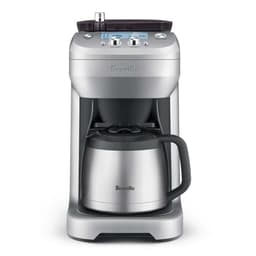
- Thermal carafe or a glass pot on a hotplate? A hotplate keeps coffee hot by continuing to cook it, and the fourth cup tastes it. Thermal costs more and is the upgrade most people notice soonest. The Breville is the only drip pick here with a dual-wall stainless thermal carafe; the Kenmore and the cheap Cuisinart are glass-on-hotplate.
- Is there a grind-off setting?This is the escape hatch, and every drip pick here has one. It lets the machine brew pre-ground coffee with the grinder bypassed — which matters for decaf, for a bag someone was given, and for the day the grinder needs cleaning.
- How does the grind chute clean?This is the complaint that shows up on every grind-and-brew ever made. Oily beans — dark roasts especially — leave residue in the chute between hopper and basket, and it builds up. It is a wipe-out-the-chute-weekly machine, not a fill-it-and-forget-it one. If the person you are buying for will never do that, buy them a plain drip machine.
Which pick suits which buyer
A shortcut if you do not want to read six write-ups:
- They buy whole beans and own no grinder: the Breville Grind Control. Real burrs, eight strength settings, thermal carafe, and it brews into a travel mug.
- You want a burr grinder but not that budget:the Kenmore Elite. Burr grinder with a grind-size selector and dose-matched grinding for roughly half the money — with a glass carafe and a thinner service network as the trade.
- It is a first-apartment or office gift: the Cuisinart DGB-400NAS. Blade grinder, but programmable, 12 cups, Brew Pause, and the longest warranty here.
- They live alone:the Cuisinart SS-GB1. Grinds per cup at 8, 10 or 12 oz, and still takes a pod. A 12-cup carafe brewed for one person is mostly waste — our best coffee makers for one person page sizes that decision properly.
- The household wants lattes AND a mug of drip: the Ninja Luxe Café Premier. SharkNinja publishes one conical burr grinder with 25 settings feeding espresso, drip and cold brew, plus a dosing scale.
- It is an espresso gift, not a coffee one: the Breville Barista Express, whose integrated conical burr grinder Breville publishes at 16 settings against an 18 g dose. Our Barista Express review goes deeper.
Espresso machines with grinders are a different purchase
Two of the six picks make espresso, and it is worth being clear that they are answering a different question. A drip grind-and-brew grinds medium and makes a mug. An espresso machine with a built-in grinder has to grind far finer, far more precisely, and repeatably — the grind is the main variable in an espresso shot, which is why a separate espresso grinder costs what a whole drip machine costs.
So do not buy an espresso machine for someone who drinks a big mug of black coffee in the morning. If you are not certain which they drink, our coffee vs espresso guide settles it quickly, and it is the single most expensive mistake in this category. If it is definitely espresso, the real fork is one box or two: Bambino vs Barista Express weighs a compact machine plus a separate grinder against one machine with the grinder built in, and best espresso machines for beginners covers the wider field.
The honest case against a built-in grinder
This page would be worth less if it did not say this plainly: for the same money, a plain brewer plus a separate burr grinder makes better coffee than any all-in-one at that price. There are three reasons, and they are all structural rather than a matter of which brand you pick.
One, the money splits. A $300 grind-and-brew is not a $300 brewer and a $300 grinder; it is roughly a $150 brewer and a $150 grinder sharing a case. Spend the same $300 on a good drip machine and a dedicated burr grinder and both halves are better than the halves inside the combo.
Two, one failure kills both. The grinder is the part with moving pieces, and in a combo it is wired to the brewer. When the grind motor goes, the coffee maker goes with it, and the whole machine is a warranty claim rather than a $90 replacement grinder. The warranties on this page run from Breville's listed one year to Cuisinart's listed three.
Three, there is no upgrade path.Someone who gets into coffee upgrades the grinder first — it is the component with the most headroom. With a combo there is nothing to upgrade without replacing the brewer too.
Buy the all-in-one anyway when convenience is the actual goal: one appliance, one plug, one footprint, no second decision for the person opening the box. That is a completely legitimate reason, and it is why this category exists. It is simply not the same as “it makes the best coffee”. If the two-machine route sounds better, start with best drip coffee makers and best coffee grinders — and for a gift, a hand grinder next to a bag of beans costs a fraction of a combo and out-grinds every blade machine here.
What to put in the box with it
A grind-and-brew is a gift that needs beans to be usable on day one, and the beans are the cheap half of the present. Whole beans, not ground — the whole point of the machine is that it grinds them.
A medium roast is the safe choice for a drip machine and the one least likely to be wrong for a taste you do not know; best coffee for beginners and light vs dark roast cover that choice. One caution specific to this category: very oily dark roasts are the beans most likely to gum up a grind chute, so if they love dark roast, buy a smaller bag and mention the weekly wipe.
Two add-ons genuinely improve the machine rather than just padding the gift. An airtight coffee canister keeps the rest of the bag out of the hopper, which matters because a hopper is a clear plastic box sitting in the light — the NCA lists air, moisture, heat and light as coffee's enemies, and a hopper is three of the four. And if the machine lives in a hard-water area, the NCA's drip guidance is to descale at least every three to six months; how to descale a coffee maker is the walkthrough, and it matters more here than on a plain brewer, because scale in a combo takes the grinder down with the brewer.
Last thing, and it is the most common regret with this category: measure the counter, including the height to the cabinet above. These machines are taller than plain drip makers because the hopper sits on top, and several of them have to be lifted out to be filled. Breville lists the Grind Control at 16.7 inches tall and SharkNinja lists the Luxe Café Premier at 20.51. A machine that does not fit under the cabinets gets used for a week and then moved.