Drip & Dose

The Best Coffee Canisters for Keeping Good Beans Good

Six coffee canisters that each get the air away from the beans a different way, from a cheap steel tin with a date wheel to one that pumps itself down. With the honest limits of each, including which two will not take ground coffee.

By Stephen V.Last updated How we choose
Fellow Atmos Vacuum Canister (0.7 L)

Our top pick — Best overall

Fellow Atmos Vacuum Canister (0.7 L)

$34.95 · View on Amazon

Price as of September 24, 2026. #ad How we’re funded

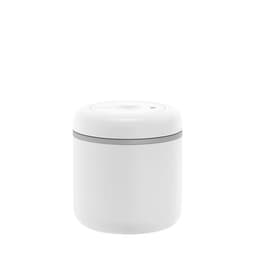
The Fellow Atmos is the one that reads as a present rather than as kitchen storage, and it does the most about the actual problem: twisting the lid pumps air out of the canister, which Fellow says creates a vacuum that helps slow oxidation. It holds up to 11 oz of beans, so a standard 12 oz bag goes in with a little to spare. Two honest limits before you buy: Fellow recommends whole beans only, because fine grounds can clog the intake valve, and it is not dishwasher safe.

Almost nobody buys themselves a coffee canister, which is exactly what makes it a good present. The bag with the fold-over clip technically works, so the canister never gets to the top of anyone’s own shopping list — and meanwhile the beans quietly go flat. The National Coffee Association names coffee’s greatest enemies as air, moisture, heat and light, and puts roasted beans at one to three weeks at room temperature, ground coffee at one to two. A canister is the cheapest thing you can buy that pushes against the first of those four.

So this page is organized around the one question that actually separates these products: how does it get the air away from the coffee? There are three answers. A vacuum canister pumps the air out. An airless canister has an inner lid you push down onto the beans, so the air is physically displaced. A valve canister simply seals and lets the carbon dioxide that fresh coffee gives off escape without letting oxygen back in. All three beat a jam jar. They cost very different amounts and they suit very different people.

Two things decide most of this for you. The first is whether the person grinds their own beans, because the two vacuum canisters here are recommended for whole beans only. The second is how much coffee they buy at a time — a 12 oz canister is useless to somebody with a two-pound bag, and a two-pound canister is just storing air for somebody who buys a small bag weekly. Our guide to storing coffee beans covers the rest of the method, and it is worth two minutes before you spend anything. We haven’t tested these; the picks are argued from the makers’ published specs and who each one suits. Prices below are pulled live, and the list runs from a genuinely cheap tin to a canister that seals itself.

How this is funded:we earn a commission if you buy through our links, at no extra cost to you. It never changes which gift we recommend, and we’ll tell you plainly when to skip one. Full disclosure.

Quick picks

Sorted by who each one suits, with a live price you can act on. Tap a row to jump to the full write-up. We haven’t lab-tested these — here’s exactly what we do instead.

#ProductBest forPrice
1
Fellow Atmos Vacuum Canister (0.7 L)

Fellow Atmos Vacuum Canister (0.7 L)

Twist the lid and a pump pulls the air out of the canister, so the beans stop sitting in a jar of oxygen between brews. A seal indicator on top shows when the vacuum has held. It is the canister that looks and feels like a present rather than kitchen storage.

Best overall
$34.95 · View on Amazon

Price as of September 24, 2026. #ad How we’re funded

2
Planetary Design Airscape Coffee Canister (Medium, 500 g)

Planetary Design Airscape Coffee Canister (Medium, 500 g)

A storage tin with an inner plunger lid that pushes the air out as it seals, so the beans aren't sitting in a jar of oxygen for two weeks. It fixes the thing that actually goes wrong with good coffee at home: it goes stale before it gets drunk.

Best without a pump
$44.00 · View on Amazon

Price as of September 24, 2026. #ad How we’re funded

3
Coffee Gator Stainless Steel Canister (16 oz)

Coffee Gator Stainless Steel Canister (16 oz)

A clamp-lid steel tin with a one-way CO2 valve, a date wheel on the lid and a scoop in the box. It does the two things a canister has to do, and it is the only one here that tells them how old the coffee is.

Best budget
$21.99 · View on Amazon

Price as of September 24, 2026. #ad How we’re funded

4
OXO Brew Coffee Storage Container (12 oz)

OXO Brew Coffee Storage Container (12 oz)

A steel tube with a one-way seal that lets CO2 out without letting air in, and a pour spout instead of a scoop. It is built around the morning rather than around the cupboard: tip it straight into the grinder and put it back.

Best for a fast morning
$44.97 · View on Amazon

Price as of September 24, 2026. #ad How we’re funded

5
Fellow Atmos Electric Vacuum Canister (0.7 L)

Fellow Atmos Electric Vacuum Canister (0.7 L)

The Atmos with the twisting taken out of it: close the lid and it pumps itself down automatically. The same 0.7 L steel body and the same whole-bean rule, at roughly double the price, bought purely so nobody has to remember to do anything.

Best splurge
$69.95 · View on Amazon

Price as of September 24, 2026. #ad How we’re funded

6
Planetary Design Airscape Kilo (2.2 lb)

Planetary Design Airscape Kilo (2.2 lb)

The big version of the Airscape, sized for the people the storage advice is actually aimed at: anyone who buys coffee two pounds at a time. Same plunger lid pushing the air out, four times the bag.

Best for a big bag
$47.49 · View on Amazon

Price as of September 24, 2026. #ad How we’re funded

The picks in full

#1Best overall

Fellow Atmos Vacuum Canister (0.7 L)

Twist the lid and a pump pulls the air out of the canister, so the beans stop sitting in a jar of oxygen between brews. A seal indicator on top shows when the vacuum has held. It is the canister that looks and feels like a present rather than kitchen storage.

Great gift for: The gift for anyone who has been given good beans — including by you. It is the piece of the setup people never buy themselves because a bag with a clip technically works.

What’s good

  • Twisting the lid pumps air out, which Fellow says slows oxidation — a jam jar only traps the air that is already in there
  • A visual indicator on the lid shows whether the vacuum actually sealed
  • Holds up to 11 oz of beans, so a standard 12 oz bag goes in with a little left over
  • Stainless steel body with a silicone handle wrap; nothing about it says 'storage container'

Worth knowing

  • Fellow recommends whole beans only — ground coffee can clog the intake valve and stop the vacuum sealing
  • Not dishwasher safe; Fellow says the built-in pump won't survive it, so it is a damp sponge and mild soap
  • Skip it if they buy a fresh small bag every week — nothing is going stale to begin with
TypeManual vacuum coffee canister
Capacity0.7 L / up to 11 oz of beans
Material301 18/8 stainless steel, silicone handle
CareHand wash only

Specs read from the product listing, on September 24, 2026. Prices are pulled live and dated on the button.

#2Best without a pump

Planetary Design Airscape Coffee Canister (Medium, 500 g)

A storage tin with an inner plunger lid that pushes the air out as it seals, so the beans aren't sitting in a jar of oxygen for two weeks. It fixes the thing that actually goes wrong with good coffee at home: it goes stale before it gets drunk.

Great gift for: The pairing gift for anyone who has been given nice beans — including by you. Hand over the beans and the tin together.

What’s good

  • Inner plunger lid pushes out excess air instead of just sealing it in
  • Holds a standard 12 oz to 500 g bag with room to scoop
  • Solid steel body that stays on a counter without looking like storage

Worth knowing

  • Two lids to handle every morning — a small extra step
  • Skip it if they buy small bags weekly; staling isn't their problem
TypeAirless bean storage canister
Capacity500 g / approx. 1 lb of whole beans
MaterialRestaurant-grade stainless steel, brushed finish
CareHand wash

Specs read from the product listing, on September 24, 2026. Prices are pulled live and dated on the button.

#3Best budget

Coffee Gator Stainless Steel Canister (16 oz)

A clamp-lid steel tin with a one-way CO2 valve, a date wheel on the lid and a scoop in the box. It does the two things a canister has to do, and it is the only one here that tells them how old the coffee is.

Great gift for: The easy add-on gift: pair it with a bag of beans and the whole present costs less than a takeout coffee habit lasts.

What’s good

  • Costs a fraction of the vacuum canisters and solves most of the same problem
  • Coffee Gator's CO2 valve vents the gas fresh coffee gives off while keeping oxygen out
  • Date wheel on the lid, so they can actually see the beans are three weeks old
  • Comes with a measuring scoop and spare valves
  • Works with ground coffee, which the vacuum canisters here do not recommend

Worth knowing

  • A clamp seal is not a vacuum — the air already inside the tin stays inside
  • 16 oz is the useful size for one household; a two-pound bag will not fit
  • Skip it if you want the canister to be the gift rather than the packaging around one
TypeClamp-lid canister with CO2-release valve
Capacity16 oz
MaterialStainless steel
IncludesMeasuring scoop, spare valves, date tracker

Specs read from the product listing, on September 24, 2026. Prices are pulled live and dated on the button.

#4Best for a fast morning

OXO Brew Coffee Storage Container (12 oz)

A steel tube with a one-way seal that lets CO2 out without letting air in, and a pour spout instead of a scoop. It is built around the morning rather than around the cupboard: tip it straight into the grinder and put it back.

Great gift for: For the person whose coffee routine is already down to ninety seconds and who does not want to add a scoop, a plunger or a pump to it.

What’s good

  • Pours directly into a grinder or brewer through a built-in spout — no scoop, no spilled beans
  • One-way seal lets the CO2 fresh coffee gives off escape while keeping air out
  • Dishwasher safe, which is unusual in this category and genuinely useful
  • Takes whole beans or grounds, so it suits a household that buys pre-ground

Worth knowing

  • 12 oz capacity means one bag at a time and no more
  • Costs about as much as the far larger Airscape Kilo — you are paying for the spout and the seal, not the volume
  • Skip it if they buy in bulk; this is a one-bag container by design
TypeOne-way-seal canister with pour spout
Capacity12 oz of whole beans or grounds
MaterialStainless steel, BPA-free
CareDishwasher safe

Specs read from the product listing, on September 24, 2026. Prices are pulled live and dated on the button.

#5Best splurge

Fellow Atmos Electric Vacuum Canister (0.7 L)

The Atmos with the twisting taken out of it: close the lid and it pumps itself down automatically. The same 0.7 L steel body and the same whole-bean rule, at roughly double the price, bought purely so nobody has to remember to do anything.

Great gift for: For the person who would love the idea of fresher coffee and would absolutely not twist a lid twenty times before their first cup.

What’s good

  • Auto-seals on its own, so the vacuum happens whether or not they remember
  • Same 0.7 L capacity as the manual Atmos — up to 11 oz of beans
  • Steel body that looks like it belongs on the counter rather than in a cupboard

Worth knowing

  • Roughly twice the price of the manual Atmos for one less twist of the wrist
  • It has a battery to charge — one more thing in the kitchen that can be flat
  • Fellow's whole-bean-only guidance applies here too: fine grounds can clog the intake valve
  • Skip it for anyone who would rather have a canister and a bag of very good beans for the same money
TypeElectric auto-seal vacuum canister
Capacity0.7 L / up to 11 oz of beans
MaterialStainless steel
CareHand wash only

Specs read from the product listing, on September 24, 2026. Prices are pulled live and dated on the button.

#6Best for a big bag

Planetary Design Airscape Kilo (2.2 lb)

The big version of the Airscape, sized for the people the storage advice is actually aimed at: anyone who buys coffee two pounds at a time. Same plunger lid pushing the air out, four times the bag.

Great gift for: For the household that buys the warehouse-club bag and then watches the last third go flat. This is the gift that fixes that without asking them to change how they shop.

What’s good

  • Planetary Design rates it for up to 2.5 lb of whole coffee — the Amazon listing is sold as 2.2 lb storage
  • The same patented inner plunger lid pushes excess air out instead of sealing it in
  • Opaque body, which the National Coffee Association's advice on light argues for over a glass jar
  • No battery, no pump, nothing to charge or clog

Worth knowing

  • It is 6.5 inches wide and 8 inches tall — a real object on a counter, not a tin in a cupboard
  • Galvanized steel with a painted finish, and Planetary Design says hand wash
  • Two lids to handle every morning, same as the smaller Airscape
  • Skip it for anyone who buys 12 oz bags; they will be storing air
TypeAirless bulk storage canister
CapacityUp to 2.5 lb of whole coffee (per Planetary Design)
Dimensions6.5" w x 8" h
CareHand wash

Specs read from the product listing, on September 24, 2026. Prices are pulled live and dated on the button.

How we picked: four things a canister has to do

Every product on this page had to clear the same four tests before it was considered, and the tests come straight out of what actually goes wrong with coffee at home rather than out of a features list.

  • It has to do something about air, not just contain it. A screw-top jar is airtight and still leaves the beans sitting in a jar of oxygen. Every pick here either removes that air or vents the CO2 while blocking new air from getting in.
  • It has to be opaque, or nearly so. Light degrades coffee, and the NCA is blunt about the fashionable clear jar of beans on a counter: treat those as decor, and store the coffee you intend to drink in something that keeps light out. Five of the six picks here are steel.
  • It has to match a real bag size.Coffee is sold in 12 oz bags and in two-pound bags, and a canister that fits neither is a canister that lives in a cupboard. Capacities below are the manufacturers’ own published figures.
  • It has to survive the morning. A canister used at 6:40am by somebody who is not awake yet needs to open and close without thought. Anything that needed a manual has been left off.

What we deliberately did notuse as a criterion is a freshness claim with a number attached. Several brands in this category advertise keeping coffee fresh “twice as long” or similar. Those are marketing figures from the companies selling the canisters, not independent measurements, so you will find the mechanism described below and the claim attributed where it is made, but you will not find us repeating a multiplier as if it were a test result.

The three sealing systems, and what each one costs you

This is the whole decision in one table. Pick the row that suits the person, then pick the size.

SystemHow it moves the airPicks hereWhat it costs you
Vacuum pumpA pump in the lid physically removes air from inside the canisterFellow Atmos, Atmos ElectricWhole beans only, hand wash only, costs the most
Airless plungerAn inner lid is pushed down onto the beans, forcing air up and outAirscape, Airscape KiloTwo lids to handle every morning
One-way valveCO2 from fresh coffee escapes; outside air cannot get back inCoffee Gator, OXO BrewThe air already inside on day one stays inside

Vacuum: the Fellow Atmos, and the version that does it for them

The Fellow Atmosis the canister most people picture when they picture a coffee canister, and it earns the position. Fellow describes the mechanism plainly: twisting the lid removes air from the canister, creating a vacuum environment that helps slow oxidation and protect flavor over time. A seal indicator on the lid tells them whether the vacuum actually held, which matters more than it sounds — a canister that has silently stopped sealing is doing nothing at all.

The 0.7 L size holds up to 11 oz of beans, which is the right size for the standard 12 oz bag most specialty roasters sell. Fellow also publishes a 0.4 L (up to 6 oz) and a 1.2 L. The body is 301 18/8 stainless steel with a silicone handle wrap, and it looks like an object rather than like storage, which is most of why it works as a gift.

Two limits are not optional reading. Fellow recommends storing only whole bean coffeein the Atmos, because ground coffee and other fine substances can clog the intake valve and stop it sealing properly. And it is not dishwasher safe — Fellow’s own line is that the integrated vacuum pump will not like it, so cleaning is a damp non-abrasive sponge and mild soap. If the person you are buying for uses pre-ground coffee, stop here and go to the Coffee Gator or the OXO instead. If they grind at home, the Atmos is the pick, and a burr grinder is the other half of the same gift.

The Atmos Electricis the same idea with the twisting removed: close the lid and it pumps itself down. It is the honest answer to “they would love this and would never actually do the twist,” and it is also roughly double the money for one motion of the wrist, with a battery to keep charged. Whole beans only still applies. Buy it for somebody who genuinely will not fuss, and buy the manual one for everybody else.

Airless: the Airscape, and the one for people who buy in bulk

Planetary Design’s Airscape takes the other route to the same place. There is no pump. Instead there is a patented inner plunger lid that is pushed down onto the beans, forcing the air up and out, and then an outer lid that closes over it. Planetary Design contrasts that directly with traditional airtight containers that trap air inside, which is a fair summary of the difference.

The practical appeal is that nothing can fail. No battery, no pump, no valve to clog, and the plunger works exactly as well on its thousandth use as its first. The Classic comes in a 250 g (about half a pound of beans) and a 500 g (about a pound), in restaurant-grade stainless steel with a non-slip base, and Planetary Design specifies hand wash. The cost is the two-lid routine: every morning there is an inner lid to lift out and push back in, and some people find that a small daily irritation rather than a satisfying ritual.

The Airscape Kilo is the same system built for the household the storage advice is really aimed at. Planetary Design rates it for up to 2.5 pounds of whole coffee, which is the warehouse-club bag, the bulk order from a roaster, or the two-pound bag that always tastes worse by the last third. It measures 6.5 inches wide by 8 inches tall, so it is a genuine object on a counter rather than something that hides in a cupboard, and it is galvanized steel with a food-safe matte painted finish, hand wash. Do not buy it for somebody who buys 12 oz bags; a canister mostly full of air is the one failure mode this whole category exists to prevent.

Valves: the cheap one, and the fast one

The third system does not try to remove air at all. It seals the coffee in and gives the carbon dioxide somewhere to go. That matters because freshly roasted coffee actively gives off CO2 for days after roasting, which is why roasters ship beans in bags with a little plastic nipple on the front. A sealed container with no valve can end up under pressure; a valve canister vents that gas without letting oxygen back in.

The Coffee Gatoris the budget pick and the most practical gift on the page for the money. It is a clamp-lid surgical-grade stainless steel tin with what Coffee Gator calls a Wicovalve CO2 release valve, on the logic that venting away the carbon dioxide released from coffee is key to keeping it tasting fresh for longer. The feature nobody else here has is the date wheel on the lid: they set it to the roast or purchase date, and from then on the canister answers the question “how old is this coffee?” without anybody having to remember. It comes with a scoop and spare valves, and unlike the vacuum canisters it is fine with ground coffee. The honest limit is that a clamp seal is not a vacuum — whatever air went in with the beans stays in there.

The OXO Brew Coffee Storage Containersolves a different problem: the thirty seconds between waking up and the grinder. It is a steel tube with a one-way airtight seal that lets CO2 escape while preventing air from entering, and instead of a scoop it has a built-in spout, so beans or grounds pour straight into a grinder or brewer. It holds up to 12 ounces of whole beans or grounds — one bag, exactly — and it is the only pick here that is dishwasher safe. What you are paying for is the spout and the seal rather than volume: it costs about as much as the far larger Airscape Kilo. For somebody whose routine is already down to ninety seconds, that is a good trade. For somebody who buys in bulk, it is the wrong container.

Size: the decision most people get wrong

Gift buyers reliably buy too large, because a bigger canister feels like a more generous present. It is the opposite. A canister sized well past what the person actually buys is a canister holding a small amount of coffee and a large amount of air, and air is the enemy the canister was bought to fight. Match the capacity to the bag, not to the shelf.

  • They buy a 12 oz bag from a local roaster. The 0.7 L Atmos (up to 11 oz), the 500 g Airscape (about a pound) or the 12 oz OXO. This is most specialty coffee drinkers.
  • They buy a standard supermarket bag. The 16 oz Coffee Gator or the 500 g Airscape, both of which swallow a pound without fuss.
  • They buy two pounds at a time. The Airscape Kilo, rated to 2.5 lb. Nothing else here is close.
  • They keep two coffees on the go— a decaf and a regular, say, or a filter roast and an espresso roast. Two smaller canisters beat one large one, and it is a better-looking gift besides. Our decaf guide covers the household that runs both.

Whole beans or ground: this rules out two of the six

This is the single most important thing to check before buying, and it takes one text message. Fellow recommends whole beans only in both Atmos canisters, because fine grounds can clog the intake valve and stop the vacuum sealing. So if the person you are buying for uses pre-ground coffee — and most people who like coffee still do — the Atmos is the wrong gift no matter how good it looks.

For a pre-ground household, the Coffee Gator and the OXO both take grounds without complaint, and the Airscape’s plunger has no valve to clog. It is also worth knowing that storage helps ground coffee less: the NCA’s figures are one to two weeks for ground against one to three for whole beans, because grinding exposes an enormous amount of surface to the air at once. If you want to fix that properly rather than slow it down, the gift is a grinder — our burr vs blade guide explains why the cheap spinning kind does not count, and hand grinders are the affordable way in.

Where it goes matters as much as which one

A good canister in a bad place is still a bad setup, and this is the part nobody puts on the box. The NCA’s advice on heat is specific: avoid cabinets near the oven or the dishwasher. The cupboard directly above the kettle is the most common bad storage spot in a kitchen and it is where most people keep coffee, because that is where the mugs are.

Moisture is the same story. Coffee is hygroscopic — it absorbs and holds moisture, along with odors and tastes, from the air around it — which is the real argument against the refrigerator, a humid box full of competing smells. The NCA lists refrigerated beans at about two weeks, shorter than well-stored beans at room temperature. If you are giving a canister, it is worth saying where to put it: a cool cupboard away from the oven, the dishwasher and the window. That sentence is free and it is worth more than the difference between any two products on this page.

What we left off, and why

  • Clear glass jars of beans.They photograph beautifully and they let light at the coffee all day. The NCA’s position is that aesthetically pleasing jars of beans are decor; the coffee you plan to drink belongs in something opaque. We looked at the glass versions of the Airscape for the people who want to see the level, and the listings were not purchasable on the day this page was written, so they are not here.
  • Vacuum-seal bags and food savers. They work, and nobody is going to run an appliance before their first coffee of the day. A canister that gets used beats a system that does not.
  • Freezer containers. Freezing is a real technique and it is a separate decision with its own rules, covered in our storage guide. For a gift, a counter canister is the one that gets used every day.
  • Pod and capsule organizers.A different problem — clutter, not staling — and pods are already sealed. They belong with gifts for pod coffee drinkers.

Matching the canister to the person

If you only know one thing about the recipient, that is usually enough to pick.

  • They grind their own beans. Fellow Atmos. It is the best version of the thing they already care about, and the vacuum is wasted on nobody.
  • They buy pre-ground. Coffee Gator, and put the money you saved into a genuinely good bag of coffee.
  • Their kitchen is already full of things they do not use. OXO Brew. It replaces the bag and the scoop, so it is a net reduction in stuff.
  • They buy coffee in bulk. Airscape Kilo, and nothing else.
  • You are building a bigger present.A canister plus beans is one of the best-value coffee gifts there is, and it is the piece people forget — our coffee gift basket guide builds around exactly that idea, and sampler sets give them several coffees to work through, which makes storage matter more rather than less.

One last piece of honesty, because it decides whether this is a good gift at all. If the person buys a small bag of coffee every week and finishes it, they do not have a staling problem and a canister will not improve their coffee. Buy them beans, a better mug or a grinder instead. A canister is for the person whose bag lasts three weeks — which, quietly, is nearly everybody.
Frequently asked questions

What is the best coffee canister?

The Fellow Atmos, for most people. Twisting the lid pumps air out of the canister, which Fellow says creates a vacuum that helps slow oxidation, and a seal indicator shows whether it actually held. The 0.7 L size takes up to 11 oz of beans, so a standard 12 oz bag fits. The catch is that Fellow recommends whole beans only, because fine grounds can clog the intake valve.

Do coffee canisters actually keep coffee fresher?

They address one of the four things the National Coffee Association names as coffee's enemies: air, moisture, heat and light. The NCA recommends moving coffee out of its retail packaging into an airtight container, and canisters that pump air out or vent CO2 while blocking oxygen go a step further than a sealed jar. They do not stop coffee aging, and roasted beans still keep for roughly one to three weeks at room temperature.

Can you store ground coffee in a vacuum canister?

Not in the Fellow Atmos or the Atmos Electric. Fellow recommends storing only whole bean coffee in them, because ground coffee and other fine substances can clog the intake valve and prevent a proper vacuum seal. For pre-ground coffee, the Coffee Gator canister and the OXO Brew container both take grounds, and the Airscape's plunger lid has no valve to clog.

What size coffee canister should I buy?

Match it to the bag they actually buy, not to the shelf. For a 12 oz specialty bag, the 0.7 L Atmos, the 500 g Airscape or the 12 oz OXO. For a standard one-pound supermarket bag, the 16 oz Coffee Gator or the 500 g Airscape. For two pounds at a time, the Airscape Kilo, which Planetary Design rates to 2.5 lb. Too large is a real mistake: a half-empty canister is mostly storing air.

Is a coffee canister a good gift?

It is one of the best cheap coffee gifts, because almost nobody buys one for themselves. The bag with a clip technically works, so the canister never reaches the top of anyone's own list while the coffee quietly goes flat. It is also the natural pairing for a bag of good beans, which turns a small budget into a complete present. The exception is someone who buys a small bag weekly and finishes it; they have no staling problem to fix.

Should a coffee canister be glass or steel?

Steel, or anything else opaque. Light degrades coffee, and the National Coffee Association's advice is to treat attractive glass jars of beans as decor and store the coffee you intend to drink in something that keeps the light out. Glass canisters do let you see how much is left, which is genuinely convenient, but a cupboard keeps light off a steel canister just as well.

Where should you keep a coffee canister?

In a cool cupboard away from heat, light and moisture. The NCA specifically advises avoiding cabinets near the oven or the dishwasher, which rules out the cupboard above the kettle where most people keep coffee. The refrigerator is not an upgrade either: coffee absorbs moisture and odors, and the NCA lists refrigerated beans at around two weeks.

Sources

  • National Coffee Association — Storage and Shelf Life — NCA on coffee's "greatest enemies" — air, moisture, heat and light — plus shelf-life figures: roasted beans 1–3 weeks at room temperature, ground coffee 1–2 weeks, frozen beans 3–4 months (accessed August 11, 2026)
  • Fellow — Atmos Vacuum Canister — Fellow: "Twisting the lid removes air from the canister, creating a vacuum environment that helps slow oxidation and protect flavor over time"; sizes of 0.4 L ("up to 6 oz"), 0.7 L ("up to 11 oz") and 1.2 L; body of "301 18/8 stainless steel, silicone wrapper handle"; "the Atmos is not dishwasher safe" because "the integrated vacuum pump won't like it"; and "We recommend storing only whole bean coffee in your Atmos. Storing ground coffee or other fine substances may clog the intake valve and prevent a proper vacuum seal." (accessed September 24, 2026)
  • Planetary Design — Airscape Classic Coffee Canister — Planetary Design: the "patented plunger lid pushes out excess oxygen and locks in freshness", "Unlike traditional airtight containers that trap air inside"; sizes holding "approx. ½ lb of coffee beans" (250 g) and "approx. 1 lb of coffee beans" (500 g); "restaurant-grade stainless steel" with a "non-slip rubber base"; BPA-free; hand wash (accessed September 24, 2026)
  • Planetary Design — Airscape Kilo Coffee Canister — Planetary Design: "The Airscape® Kilo Coffee Canister has a storage capacity of up to 2.5 pounds of whole coffee", with "a patented inner lid that forces air out and locks in freshness, preventing your coffee beans from going stale"; "Made with high-quality galvanized steel and coated with a food-safe matte-painted finish"; "Measures: 6.5″w x 8″ h"; BPA-free; hand wash (accessed September 24, 2026)
  • Coffee Gator — Stainless Steel Canister, 16 oz — Coffee Gator: "16 oz Capacity: Ideal size for daily coffee drinkers"; a "Wicovalve CO2 release valve", because "Venting away flavor-sapping carbon dioxide released from coffee is key to keeping your brew tasting fresh for longer"; a "Freshness Tracker: Mark the purchase or expiry date easily" via a "Date wheel for tracking best before or roasting date"; a "Surgical-grade stainless steel body" that "Guards against light, moisture, and air"; "Each canister comes with spare valves"; dimensions 6" L x 5" W x 5.91" H (accessed September 24, 2026)
  • OXO Brew Coffee Storage Container — published specifications (retailer listing; oxo.com returns HTTP 403) — OXO's published specifications for the Brew Coffee Storage Container: "Large capacity holds up to 12 ounces of whole coffee beans or grounds"; "One-way airtight seal keeps coffee fresh by allowing CO₂ to escape while preventing air from entering"; "No-Scoop Dispensing means you can pour beans or grounds directly into grinders or brewers with the built-in spout"; "Made of stainless steel"; BPA-free; "Dishwasher safe"; 3.6" diameter x 8" high (accessed September 24, 2026)

Keep reading