How to think about footprint, in the order it bites
1. Width is the number people quote; height is the number that hurts
Espresso machines are usually sold on width, because that is the flattering dimension for a narrow body. But a small kitchen’s real constraint is almost always the underside of a wall cabinet, and the figure that matters is not the machine’s height — it is the height with the lid of the water tank open, or with the tank lifted out, depending on how it refills. Measure that gap before you buy anything on this page.
2. Depth with the drip tray, not without it
Published depths sometimes exclude the drip tray and always exclude the gap you need behind the machine for the power cable. On a standard shallow counter this is what decides whether a machine sits flush or overhangs.
3. Does the tank fill from the front?
A front- or side-filling reservoir can live under a cabinet permanently. A top-filling tank cannot, unless the clearance is generous. This single difference changes whether the machine is used daily or occasionally.
4. The grinder is the hidden second appliance
This is the trap in buying a small espresso machine. Most of these do not grind, and espresso needs a fresh, fine, consistent grind — so the real footprint is machine plus grinder. On a tight counter the answer is usually a hand grinder, which lives in a drawer and costs less than an electric one. Our grinders under $200 page has the ones worth owning, and the two pod-and-press picks here dodge the problem entirely.
5. No fabricated scores
We own none of these machines. Specs are the manufacturers’ own published figures; the ranking is editorial reasoning about fit, documented on how we choose.
The four kinds of “compact”, and who each suits
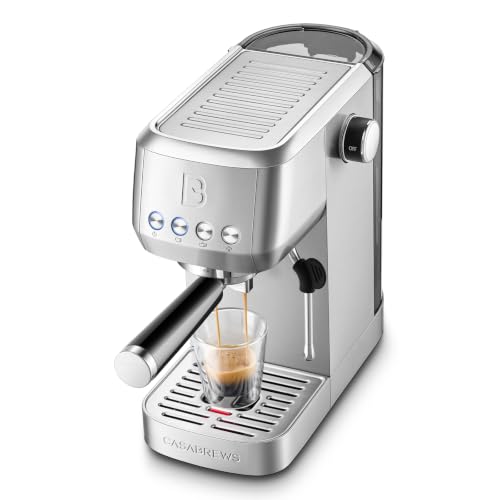
A narrow pump machine — the Dedica, the CASABREWS
A full espresso machine with a slim body. You get a portafilter, a steam wand and the whole experience; you give up nothing except the width of the tank-and-boiler layout. This is the right answer for the great majority of people, and the Dedica has been the reference point in this category for years precisely because it is a real machine in a slim case.
A small-but-serious machine — the Bambino
The Bambino is narrow in its own right — Breville publishes its dimensions as 11.9 x 6.1 x 13.5 inches and its weight as 10.42 lbs — and it makes better espresso than anything else on this list: a 54mm portafilter with a published 18 g dose, 9-bar extraction after low-pressure pre-infusion, PID temperature control, and the ThermoJet system Breville publishes as hitting optimum extraction temperature in three seconds. It costs more than the Dedica, which is the only reason it is not the top pick — the full Bambino review covers why.
A capsule machine — the Essenza Mini
The smallest actual machine here and the only one that needs no grinder, no tamping and no skill. The catch is the one every pod machine has: it commits the recipient to one capsule line. Nespresso publishes that Original machines “use Original coffee pods only” and that Vertuo pods fit Vertuo machines only — the Essenza Mini is Original, which is the espresso-drinker’s line. See best pod coffee makers if that is the direction you are going.
A machine with no footprint at all — the Picopresso, the Flair 2GO
These are hand-powered presses that live in a drawer or a bag and come out when needed. Wacaco calls the Picopresso “the most compact and pro-oriented of our portable espresso machines” and publishes a naked portafilter over a standard 52mm, 18 g stainless basket — but is equally blunt that “there are no shortcuts” and that the owner has to master grind, tamp and pull. The Flair 2GO is a collapsible lever press. Both need hot water from somewhere else, because Wacaco states the Picopresso “does not heat up water”, and both need you to care about the process. For someone who enjoys that, they are the best answer to no counter space there is — see portable espresso makers and Nanopresso vs Picopresso.
What you give up by going small
Being straight about this matters, because a gift that disappoints on the fourth morning is worse than one that disappoints on the first.
- Steam power and milk capacity. Small boilers steam more slowly and hold less. One latte is fine; three in a row is a different machine. If milk drinks are the main event, look at machines with a milk system.
- Back-to-back shots. Small thermoblocks recover fast but small tanks run dry, and on a compact machine you will be refilling.
- Portafilter size, on the cheapest machines. A smaller or pressurised basket is more forgiving of a poor grind and less capable at its ceiling. That is a sensible trade for a beginner and a frustration for someone who wants to improve.
- Upgrade paths.A compact machine is rarely a machine you modify. If the recipient is the type to tinker, the honest answer is a 58mm machine and a bigger counter — see the Gaggia Classic review.
Which to give, by kitchen
- A narrow gap, and they want real espresso— Dedica.
- A narrow gap and a small budget— CASABREWS 3700.
- The coffee matters most and the budget allows it— Bambino.
- No interest in learning, and almost no space— Essenza Mini plus a box of capsules.
- Literally no spare counter— Picopresso or Flair 2GO, both of which live in a drawer. These also travel, which makes them the right gift for someone in a dorm, a van or a rented room — see travel coffee makers.
Whatever you pick, remember the second appliance. A compact machine and a hand grinder together take less space than one mid-sized all-in-one, and that pair is the actual recommendation this page is making.
The smallest footprint of all belongs to a machine with no pump, no boiler and nothing to plug in. A manual lever press takes a corner of counter and disassembles into a drawer, at the cost of about five minutes per shot — our Flair 49 PRO review is the honest account of that trade for the household that is short on space and long on patience.