The order worth buying them in
1. A real tamper
Nearly every espresso machine ships with a small plastic tamper, and nearly every one of them is too small for the basket and too light to press evenly. An undersized tamper leaves a ring of loose coffee around the edge of the puck, and water goes through loose coffee rather than through the middle — which is exactly the channeling that makes shots gush.
A correctly-sized, weighted tamper is therefore the first accessory, and a spring-loaded one removes the “how hard should I press?” question entirely by clicking at a set pressure. For a beginner, that consistency is worth more than the extra force.
2. A distribution tool
Coffee comes out of a grinder in clumps. Tamping a clumpy bed traps air pockets and dense patches, and water finds the easy route through. Stirring the grounds with fine needles before tamping — the technique known as WDT — breaks the clumps up so the bed is uniform.
It is a genuinely effective fix, it costs very little, and it is the single most common answer on espresso forums to “why is every shot different?” The cost is one extra step per shot. Our bitter espresso guide covers the other causes worth checking first.
3. A milk pitcher, if they drink milk drinks
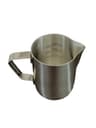
Steaming milk in anything without a spout is a losing game. A proper pitcher has a sharp, defined spout that lets you place the milk where you want it, which is what makes latte art possible at all, and etched interior markings so they can measure without a jug.
Size matters more than people expect: too large and the steam wand cannot create a vortex in a small volume of milk, too small and it overflows. Around 12 oz suits one or two drinks, which is what most households make. See milk frothers if their machine has no steam wand at all.
4. A knock box
This one improves nothing about the coffee and a great deal about living with an espresso machine. Spent pucks have to go somewhere, and the alternatives are a bin across the kitchen, a bowl on the counter, or the sink — which eventually blocks. A knock box takes the puck in one movement.
It is the accessory most likely to be appreciated by whoever shares the kitchen with the espresso drinker, which is not nothing.
5. Something to measure the shot
Espresso is a ratio: roughly 18 grams of coffee in, roughly 36 grams of liquid out, in roughly 25 to 30 seconds. Without measuring the output, there is no way to know whether a shot was short and sour or long and thin, so there is nothing to adjust.
The proper answer is a small scale on the drip tray, covered in our coffee scales roundup. Graduated shot glasses are the cheap version: less precise, but they turn an invisible variable into a visible one, which is most of the benefit.
6. A tamping mat
A small thing that protects a worktop and the portafilter spouts, stops the portafilter sliding while it is tamped, and costs about as much as two coffees. Nobody asks for one and everybody uses one.
What we would skip
Bottomless portafiltersare a diagnostic tool, not an improvement — they let you see channeling, which is useful once you know what you are looking at and messy before then. Also machine-specific, so a risky gift.
Puck screens and precision baskets make small, real differences for people already extracting well. For someone whose shots are inconsistent, the tamper and the distribution tool do far more.
Branded cleaning tablets and detergents are necessary but a joyless gift. Include them alongside something else, never on their own.
Anything sized to a portafilter you have not checked. A 58mm tamper in a 54mm machine is useless and has to go back, which is a bad start to a present.
Building a complete espresso gift
Around $50: a distribution tool, a tamping mat, and a bag of fresh espresso beans. A small, thoughtful, genuinely useful set for someone who already has a machine.
Around $100:add a proper tamper. This is the version we would give — it covers the two things that actually change shot consistency and still looks like a considered present rather than a parts order.
Around $150: add a milk pitcher and a knock box, and it becomes a complete kit for someone who has just been given a machine. Pair it with good espresso beans, or see gifts for espresso lovers for the wider list.