Work out what they already have before you buy anything
Thirty seconds of thinking here saves you from the most common failure in this category, which is buying a duplicate. Pour-over people accumulate gear in a predictable order, and you can usually place someone on it from a single visit to their kitchen.
The dripper comes first, almost always. Then a kettle — but frequently an ordinary one, because a gooseneck feels like an indulgence when you are starting out. Then, much later and often never, a scale, because weighing coffee sounds fussy until you have done it once. The grinder is the odd one out: it is the biggest upgrade available and the one people put off longest, because it is also the most expensive single item and a bag of pre-ground coffee works well enough to hide the problem.
That gives you a simple rule. If you can picture a burr grinder on their counter, buy the kettle. If you cannot, buy the grinder. If they have both, buy the scale or the coffee. And if you have never seen their kitchen at all, skip to the coffee — it is the only pick here that cannot possibly duplicate something they own.
Why the grinder is the top pick, and not a close call
The National Coffee Association’s pour-over guidance calls for a medium grind, which it compares to kosher salt. The word doing the work in that sentence is not medium. It is the implied consistency: a bed of evenly sized particles that water can pass through at an even rate.
A blade grinder cannot produce that. It chops, and chopping gives you dust and boulders in the same batch. In a pour-over that is a specific and visible failure — the dust clogs the filter and over-extracts into bitterness while the boulders barely give anything up, and the same technique produces a different cup every morning for no reason the brewer can identify. A burr grinder crushes the beans to a set gap instead, which is why it is the upgrade people describe as transformative and a new dripper never is.
Pre-ground coffee has the same problem in a different shape. It is ground to one compromise setting for every brew method at once, and it starts going stale immediately — the NCA puts ground coffee at one to two weeks of useful life against one to three weeks for whole beans. Someone brewing by hand has already chosen to spend three minutes on their coffee; giving them the ability to grind for it is giving them the payoff for the effort they are already making. Our burr vs blade grinder explainer has the full version of this if you want to be sure before spending, and best coffee grinders covers the electric and hand options at every budget.
The kettle: the gift they will actually show people
A gooseneck kettle does two things a normal kettle cannot, and both of them matter for this brew method specifically.
The first is temperature. The NCA puts pour-over water at 93 ± 3 °C — roughly 194 to 205 °F — which is not what a standard kettle gives you, because a standard kettle gives you boiling. Water straight off the boil scalds the grounds and pulls out the harsh end of the flavor, and the usual workaround is to boil, then stand there guessing how long to wait. A variable-temperature kettle removes the guess.
The second is the spout. The narrow curved neck turns a pour into something you can aim and slow down, which is the entire technique: the NCA describes blooming with double the coffee’s weight in water, waiting about 30 to 45 seconds until the grounds stop bubbling, then pouring the rest slowly and continuously from the middle outward in a spiral, for two to four minutes of total contact. None of that is possible from a wide kettle spout that dumps half the water in one go.
There are two on this list on purpose, because this is the pick where the budget question is real rather than invented. The Cosori is the honest recommendation for most gift buyers: preset temperatures, a gooseneck spout, a fraction of the price. The Fellow Stagg EKG Pro is the one people put on display and recognize on sight, and if the gift needs to look like a significant present as well as be one, it is the safest wow in coffee. Buy the Cosori if they are new to this; buy the Stagg if they are already deep in it and you want them to know you noticed. The best gooseneck kettles roundup compares them properly if you want to see the middle ground too.
The scale is the cheapest thing on this page that changes the coffee
This is the pick most people skip and the one with the best ratio of price to improvement. The NCA specifies pour-over as 1 gram of coffee to 13–16 grams of water. That is a ratio, and a ratio cannot be hit with a scoop, because coffee beans do not have a fixed density — a level tablespoon of a light roast and a level tablespoon of an oily dark roast are different amounts of coffee, and the same scoop of the same bag varies with how you dig it out.
The practical effect is that somebody eyeballing their dose is brewing a slightly different coffee every day and cannot tell which variable moved. Weigh both sides once and the mornings stop being random; more usefully, when a cup isgood, they can make it again. The timer built into a brew scale covers the other half of the method — the 30 to 45 second bloom and the two-to-four-minute total — without a phone propped against the kettle.
It is a small gift, and we would not send it on its own for an occasion that needs weight. Paired with a bag of coffee, though, it is a complete and thoughtful present for well under fifty dollars, and it is the single item on this page most likely to be met with “I have been meaning to get one of these.” Our best coffee scales guide has the full range if you want a faster or prettier one.
If you are buying the brewer itself
One brewer made this list, and it is here for the two cases where a dripper is the right present: they do not own one yet, or they own a plastic cone and the gift is an upgrade in kind rather than in function.
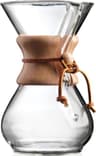
The Chemex earns the slot because it is the pour-over that reads as a gift. It is a single piece of glass that brews and serves, it is in the Museum of Modern Art’s collection, and it makes a notably clean cup because its filters are thick. That last point is also the catch, and it is worth saying out loud before you buy: those filters are proprietary, they are thicker than standard ones, and when the box runs out the recipient has to buy Chemex filters specifically rather than pick up a packet of anything. It is a real ongoing cost and it is the reason we would not hand one to somebody who values convenience over ceremony.
If the brewer is genuinely the gift, read the full comparison first — the flat-bottomed and hands-off options suit different people, and the differences are larger than they look. Our pour-over coffee maker roundup covers all of them, and pour-over vs French press is the page to read if you are not certain which camp they are in.
Buying the coffee: roast first, grind second
A bag of beans is the safest gift on this page and the easiest to get subtly wrong. Two rules cover almost every case.
Buy whole bean, but only if they can grind it. For a pour-over drinker with a burr grinder this is straightforward and whole bean is simply better. For somebody without one, whole beans are a bag of coffee they cannot drink, which is a worse gift than the cheaper pre-ground alternative. If you are buying the grinder as well, this stops being a question.
Aim medium and do not try to be clever.The NCA notes that light roasts are matte with no surface oil while dark roasts are shiny and oily, and that dark roast’s strong flavor is not a caffeine effect. Roast preference is genuinely personal, and a pour-over drinker who wants bright fruity light-roast coffee has probably already found a roaster they like. A well-made medium roast is the bag that lands for the widest range of people, and it is a gift rather than an argument. The sampler is the other good answer here — four different origins gives somebody who already has all the equipment the one thing gear cannot provide, which is something new to taste.
Whatever you pick, it goes stale: the NCA puts roasted beans at one to three weeks at room temperature, so this is a gift to be opened and used rather than saved. For the full bag-by-bag list, best coffee beans for pour-over and drip goes through the options, and how to store coffee beans covers keeping the last of the bag as good as the first.
Four cases, four different answers
The right pick changes completely depending on which of these you recognize.
They brew pour-over with pre-ground supermarket coffee. Buy the grinder. Everything else on this list is an improvement at the margins compared with fixing the grind, and this is the person who will notice the difference the first morning.
They grind their own but boil the kettle and pour. Buy the kettle. They have already done the expensive part and are losing most of the benefit to water that is too hot and going in too fast.
They have the grinder and the gooseneck. This person is hard to shop for with equipment and easy to shop for with coffee. Give them the sampler, or the scale if you know they still measure by eye. A duplicate of something they chose themselves is the one outcome to avoid.
You are not sure they brew pour-over at all. Then do not buy pour-over gear on a guess. Start with how to choose a coffee gift, which has the five questions that narrow this down fast, or move to a budget list like coffee gifts under $50 where the picks work for any brewing method.
What we deliberately left off
No filter packs as a main gift. A box of filters is a genuinely useful thing to tuck alongside a brewer, and a genuinely bleak thing to unwrap on its own.
No automatic pour-over machines. They are legitimate appliances and we recommend the good ones on best drip coffee makers, but they are the wrong present for this recipient specifically: somebody who chose to brew by hand chose the three minutes on purpose, and a machine that removes them is solving a problem they do not have.
No mugs. Not because there is anything wrong with a good mug — there are lovely ones on best coffee mugs— but because it is the default coffee gift, everyone receives several, and the whole advantage of knowing that somebody brews pour-over is that you can do considerably better than the default. And no branded coffee merchandise: a t-shirt about coffee is not a coffee gift.