How cold brew actually works
Coarse grounds sit in cold water for roughly twelve to twenty-four hours, usually in the fridge. Because the water never gets hot, it extracts different compounds than a hot brew does — less of the acidity and bitterness, more of the sweetness and body. The result is a concentrate you cut with water or milk, or in the case of a simpler jug, a ready-to-drink coffee.
Two things people get wrong. First, cold brew is not iced coffee: iced coffee is brewed hot and chilled, which keeps the bright, acidic notes. Second, cold brew is not automatically lower in caffeine — a concentrate is usually considerably stronger than drip until it is diluted.
Concentrate versus ready-to-drink
Concentrate systems (the two OXOs, the County Line jar) brew something roughly two to three times the strength of normal coffee. That is the better choice for most people: it keeps for a week or more in the fridge, it takes up less space per serving, and it can be diluted hot as well as cold, so it works in January. It also needs a slightly heavier hand with the coffee, about 1 part coffee to 5 parts water by weight.
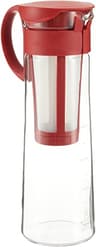
Ready-to-drink jugs (Hario Mizudashi, the Bodum) brew coffee at normal drinking strength. Less to think about, less flexible, and the whole batch is gone faster. For someone who wants a glass of cold coffee in the morning and nothing more complicated, they are the right gift.
The straining question
The reason cheap DIY cold brew (grounds in a mason jar, strained through cheesecloth) doesn’t become a habit is the clean-up. Every maker on this list has a built-in filter, so the whole process is: fill, wait, remove the basket or open the valve. That single design decision is why a $25 purpose-made jug beats a free jar for actually changing what someone drinks.
Grind, ratio and time
Cold brew wants a coarsegrind, like raw sugar or coarser — finer coffee over-extracts across a twelve-hour steep and turns muddy and bitter. Start at about 1 part coffee to 5 parts water for concentrate, or 1 to 8 for ready-to-drink, and steep twelve hours in the fridge or eight at room temperature. Our grind size guide covers the full scale, and a burr grinder is what makes a genuinely coarse, even grind possible — blade grinders can’t do it.
Beans matter less here than in any other method, which is good news for a gift: cold brew is forgiving, and a bold medium-dark roast tends to work beautifully. Any of the bags in our beans guide will do the job.
Buying one of these as a present rather than for yourself? The maker is only part of it — coarse-ground coffee, something to drink it out of and a way to stop the ice watering it down all matter as much as the brewer does. Gifts for iced coffee lovers puts the whole set together for the person who drinks it cold.