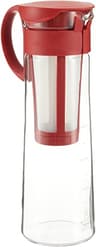
The short version, before the detail. Cold brew is coffee brewed with cold water over many hours — the National Coffee Association’s guidance is a coarse grind “like rock salt”, a 1:4 to 1:5 ratio of coffee to water, room-temperature or cooler water, and approximately 12 hours of contact before straining. Iced coffee is coffee brewed hot by any normal method and then cooled down, which is the NCA’s own distinction. Everything else — the taste, the strength, the equipment, the price in a cafe — follows from those two sentences.
Notice what the ratio means. At 1:4, cold brew leaves the jug as a concentrate, four or five times as dense as the 1:13 to 1:16 a pour-over is brewed at. It is not supposed to be drunk as it comes. That single fact explains most of the confusion: people try undiluted cold brew, find it overwhelming, and conclude cold brew is “strong”, when what they actually had was an unmixed drink.
For a gift buyer, the practical consequence is simpler still. Cold brew needs equipment and planning — a vessel, a filter, fridge space and a decision made the night before. Iced coffee needs nothing they do not already own. So cold brew gear is a great gift for someone who drinks iced coffee daily, and a poor one for someone who likes it occasionally in July.
Side by side
| | Cold brew | Iced coffee |
|---|
| How it is brewed | Room-temperature or cooler water, roughly 12 hours of contact (NCA) | Brewed hot by any standard method, then cooled down (NCA) |
|---|
| Grind | Coarse, “like rock salt” (NCA) | Whatever the hot method needs — usually medium |
|---|
| Ratio | 1:4 to 1:5 coffee to water — a concentrate (NCA) | The method's normal ratio, e.g. 1:13–1:16 for pour-over |
|---|
| Time to a drink | Overnight, planned in advance | Minutes |
|---|
| Served | Diluted with water or milk over ice | Poured over ice as it is |
|---|
| Equipment | A brewing vessel with a filter, and fridge space | Whatever they already own, plus ice |
|---|
| Best gift for | Someone who drinks iced coffee every day | Someone who wants one on a hot afternoon |
|---|
Which one is stronger?
The honest answer is: it depends entirely on how it was diluted, and anyone who gives you a single number for either drink is guessing.
Here is what can be said from published figures. The FDA’s table puts regular brewed, non-specialty coffee at 113 to 247 mg of caffeine per 12 fluid ounces — a range of more than two to one, before anyone adds ice. Cold brew leaves the vessel at a 1:4 to 1:5 ratio against roughly 1:16 for filter coffee, so the concentrate is several times denser; once it is cut with water or milk to drinking strength, it lands somewhere in or near that same broad range. A big cold brew from a chain can easily carry more caffeine than a mug of drip, and a heavily diluted homemade one can carry less.
Which is why the useful question for a gift buyer is not strength but consistency. Cold brew made as a concentrate and diluted the same way each time is extremely repeatable. Iced coffee poured over a random amount of ice is not — which brings us to the real problem with iced coffee.
The dilution problem, and the two fixes
Pour hot coffee over ice and some of that ice melts immediately. The drink you end up holding is coffee plus however much water the ice gave up, which is why homemade iced coffee so often tastes thin and slightly stale. It is not a bad brew; it is a correctly brewed coffee that has been watered down by a quantity nobody measured.
Two fixes, both free:
- Brew stronger, on purpose, then pour over ice. Use more coffee for the same water so the melt lands you back at normal strength. This is the approach behind brewing hot directly over ice — a smaller volume of concentrated hot coffee hitting a full glass of ice, chilled in seconds.
- Chill the coffee first, then add ice to a cold drink. Cold coffee barely melts ice. Brew a batch, refrigerate it, and pour it over ice when you want it. Less dramatic, and it works with any brewer they already own.
A third, cheaper-than-it-sounds fix: bigger ice. A large cube has less surface area for its volume than a handful of small ones, so it melts more slowly and dilutes less. It is the only piece of “iced coffee equipment” that genuinely changes the drink, which is why an ice tray is on the list below.
Our how to make iced coffee guide walks through both methods step by step, and how to make cold brew coffee covers the overnight route.
How each one tastes, honestly
Cold brew is usually described as rounder and softer, and the reason is in the method rather than in any mystery: water that never gets hot extracts differently, and a long gentle steep followed by straining through paper, cloth or fine mesh — the NCA’s three filter options — leaves a drink with less of the sharp edge that hot brewing pulls out. People who find hot coffee harsh frequently like cold brew; people who love a bright, acidic pour-over often find cold brew flat.
Iced coffee keeps the character of the hot brew it came from, including the acidity and aromatics, which is exactly why specialty cafes often prefer it for good single origins. If the beans cost real money, iced coffee shows them off. If the beans are a supermarket dark roast, cold brew flatters them. That is the most useful way to choose between the two at home, and it also tells you which bag to buy — best coffee for cold brew leans coarse-ground and chocolatey for a reason.
What to look for in cold brew equipment
Cold brew is the one of the two drinks that needs anything bought, so this is where a gift decision actually happens. Four things matter and nothing else does.
- A filter you can lift out. Cold brew is coffee sitting in water for twelve hours; the brew ends when you separate them. A brewer with a removable mesh basket does that in one movement. Without one you are pouring a slurry through a cloth over a sink.
- Fridge-shaped, with a lid you can pour through. It lives in the fridge for days. Tall and narrow beats wide, and a spout beats decanting.
- Capacity matched to the habit, remembering it is concentrate. At 1:4 to 1:5, a 32 oz brewer is not 32 oz of drinks — diluted, it is considerably more. One batch a week is a realistic target for a single drinker.
- Glass or plastic, deliberately. Glass is nicer and heavier and breaks; the plastic ones survive a shared fridge and a dishwasher. For a gift, glass reads better; for a household with kids, plastic lasts longer.
Notice what is not on that list: anything electric. Cold brew is the one brewing method where the appliance version adds nothing — the process is time, and time is free. A jar with a filter does the same job as a machine.
Three cold brew makers and one thing for iced coffee
Three brewers at three sizes and price points, plus the single piece of equipment that improves iced coffee. Prices are pulled live and dated on each button.