Which recipe do they make? That is the whole decision
Before you look at a single bag, answer this: when they use the AeroPress, do they end up with a full mug of black coffee, or a small strong shot they add milk or water to? Those are the two camps, and you can usually tell from the mug they reach for.
The mug recipe uses a lot of water relative to the coffee — something in the region of 15 or 17 grams of coffee to 250 grams of water, which is roughly the ratio a drip machine uses. The National Coffee Association’s drip guidance calls for a medium grind, “like kosher salt”, and a Golden Ratio of one to two tablespoons of ground coffee per 6 oz of water. At that dilution you taste the whole cup: acidity, sweetness, the fruit. This recipe rewards a medium or light roast with something to say.
The concentrate recipe uses far less water — a fraction of a mug — pressed through a finer grind, then diluted into an americano or topped with frothed milk. This is not espresso, and it is worth being straight about that: real espresso is defined by pressure, and the NCA describes it as nearly boiling water forced through a fine grind at high pressure in 20 to 30 seconds, which a hand-pressed plunger does not do. But the drink is espresso-shaped, and what matters in an espresso-shaped drink is body, not delicacy. Milk flattens acidity and eats subtlety. A dark, syrupy blend survives it; a delicate light roast does not.
If the answer is “both, depending on the day” — which is common, because the whole appeal of an AeroPress is that it switches — buy a medium roast and stop thinking about it. That is the top pick, and it is the right call for most gift buyers.
The three things that actually matter in the bag
Once you have the recipe, these are the specs worth reading on the label. The rest — altitude, varietal, the farm’s name — are interesting and will not change whether your present gets used.
- Whole bean, and whether they own a grinder. This is the one that ruins gifts. Whole beans are better coffee — the NCA puts roasted beans at one to three weeks of freshness at room temperature against one to two for ground — but they are useless to someone with nothing to grind them in. The AeroPress crowd skews toward owning a hand grinder, and it is the single most common AeroPress accessory, but do not assume. If you are not sure, read whole bean vs ground coffee before you buy, or pair the bag with a hand grinder and make it a kit.
- Roast level, which the bag always states. The NCA describes light roasts as matte with no surface oil and dark roasts as shiny and oily, and — usefully, because this myth will not die — notes that the strong flavor of a dark roast “is not associated with caffeine levels”. Light roasts actually carry slightly more. If you want the full explanation, light vs dark roast covers it.
- Bag size against how fast they drink it. A 12 oz bag is roughly three weeks of one AeroPress a day, which is about as long as the coffee stays good anyway. A 2 lb bag is a worse gift than it looks: most of it will go stale before they reach it unless it goes straight into an airtight canister.
Which pick suits which buyer
A shortcut if you do not want to read six write-ups:
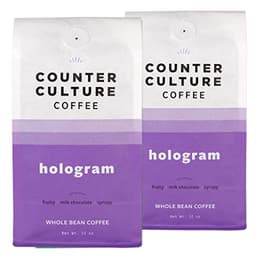
- You have no idea what they like: Counter Culture Hologram. Medium, sweet, chocolate-and-fruit, and published as working across every brew method. Two bags, so it reads as a present.
- They already drink specialty coffee and like it bright: Onyx Geometry. Onyx publishes it as a light roast at Agtron #130 with berries, stone fruit and Earl Grey, and — unusually — says they love it “as a filter coffee” and “as espresso”, which is the rare bag that covers both AeroPress recipes from one purchase.
- They make AeroPress lattes or americanos: Onyx Monarch. Published as an “expressive dark” at Agtron #99.5 with dark chocolate, molasses and a thick, syrupy body — which is the characteristic that survives milk.
- You want it to be good and cheap: Kicking Horse Three Sisters. An organic, Fairtrade medium roast at supermarket money that handles the mug recipe perfectly well. Specialty coffee is better; it is also several times the price per pound.
- They have cut back on caffeine: Peet’s Decaf Major Dickason’s. Decaffeination removes roughly 97% of the caffeine per the NCA, leaving about 2 to 15 mg per 8 oz cup against about 95 mg for regular coffee — so this is a real evening cup, and anyone who has cut back is used to being handed the worst bag in the shop. Our best decaf coffee page has the wider field.
- You are genuinely guessing: the Atlas Coffee Club 4-pack. Four single origins in four small bags, which also happens to be the right shape of gift for a traveler — see the AeroPress Go section below.
Why an AeroPress is more forgiving than the bean snobs admit
One reassuring thing, if you are nervous about picking the wrong bag. The AeroPress is harder to ruin than a pour-over cone, and that is structural rather than a matter of taste.
A pour-over is a percolation brewer: water passes through the bed once, and how evenly it passes through depends entirely on the person pouring. An uneven pour over an uneven grind gives you bitter dust and sour boulders in the same cup. The AeroPress steeps — the coffee sits in the water like a French press — and steeping is far less sensitive to grind consistency, because every particle gets the same contact time whether it is the right size or not.
Then it pushes everything through a paper filter, which catches the fines and most of the oils. That is why AeroPress coffee tastes cleaner than French press coffee from the same beans, and why a slightly-wrong bag still produces something drinkable. Our AeroPress vs French press comparison goes into what that filter changes.
The practical consequence for a gift buyer: you have more margin for error here than on any other brewer this site covers. A medium roast in an AeroPress will be fine. It is only the extremes — a very light, very acidic bag handed to a milk-and-sugar drinker, or an oily dark roast handed to someone who bought the thing specifically to taste Ethiopian fruit — that genuinely miss.
Buying for an AeroPress Go? Buy differently
The AeroPress Go is the travel version, and it changes the bean decision in two ways that are easy to miss.
Bag size matters more than bag quality. Nobody packs a 12 oz bag of coffee for four days away, and a part-used bag rattling around a suitcase goes stale fast — the NCA lists air, moisture, heat and light as coffee’s four enemies, and a suitcase supplies at least three. Four small bags beat one big one, which is exactly why the Atlas sampler is on this list.
They may not be taking a grinder. A hand grinder is a reasonable thing to pack for a two-week trip and an unreasonable thing to pack for a weekend. If the person you are buying for travels light, a pre-ground bag is the honest answer even though it is the worse coffee — ground coffee keeps one to two weeks per the NCA, which covers a trip. Do not buy whole beans for a travel kit that has no grinder in it.
If the AeroPress Go itself is the gift rather than the beans, best coffee makers for one person and our AeroPress review cover which version to buy.
What to put in the box with the beans
Beans are the cheap half of a good coffee present, which makes them the easiest thing to build a gift around. Three add-ons genuinely improve an AeroPress rather than padding the bag out.
A hand grinder is the biggest single upgrade for anyone drinking pre-ground, and the AeroPress is the brewer where a cheap hand grinder performs best, because a steeping brewer tolerates a less consistent grind. Our best manual coffee grinders page sizes that properly, and burr vs blade grinder explains why the cheap electric one on the end of the supermarket aisle is not the same purchase.
An airtight canister is the unglamorous gift that actually extends the life of every bag they buy afterwards. The NCA is blunt about coffee’s enemies being air, moisture, heat and light, and the bag the coffee came in addresses one of the four. See best coffee canisters and how to store coffee beans.
A scale is the add-on we are most cautious about recommending, and we will not oversell it: it matters for espresso and pour-over far more than it does here, because a steeping brewer with a paper filter forgives imprecision. It is a strong second gift and a weak first one — do you need a coffee scale gives the honest yes-or-no per brewer.
Last thing, and it is the most common AeroPress regret: do not buy a 2 lb bag as a present unless a canister goes in the box with it. Big bags look generous and taste worse by week five.