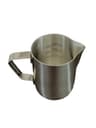
The whole drink turns on one decision, made in about three seconds, with the steam wand just under the surface of the milk: how long you let air in. Stretch the milk briefly and you have a latte. Keep stretching and you have a cappuccino. Everything else — the shot, the pitcher, the pouring — is shared between the two drinks.
That is worth stating plainly because almost every “how to make a cappuccino” recipe gives you proportions (a third, a third, a third) and nothing about technique, and proportions are the output, not the input. You do not measure a third of foam into a cup. You texture the milk so that it arrives as a third of foam.
The useful fixed points come from the drinks either side of it. Merriam-Webster defines a latte as “espresso mixed with hot or steamed milk” and a flat white as “espresso coffee topped with a thin layer of steamed milk”. A cappuccino belongs in that family with the most foam and the least liquid milk of the three. If you can taste the espresso clearly through a thick, soft cap, you have made one.
What you need
- A source of espresso. A machine is the real answer; a moka pot is the honest substitute. The NCA’s description of espresso is nearly boiling water forced through a fine grind at high pressure, roughly 1:2 dry coffee to liquid, over 20 to 30 seconds — and a drip coffee maker does none of those things, which is why drip coffee with foam on it is not a cappuccino.
- A way to texture milk. A steam wand, an automatic frother or a jar and a microwave, in descending order of control.
- A metal pitcher, if you are using a wand. Metal because you judge the temperature with your hand on the outside of it, which you cannot do through ceramic or glass. A 12 oz pitcher is the standard size for one drink.
- A cup that is smaller than you think. A cappuccino in a large mug becomes a latte by volume no matter how well you textured the milk. Six to eight ounces is the traditional territory; an 11 oz cup is the upper limit before the ratio collapses.
The method, step by step
1. Pull a short, strong shot
A cappuccino is built on espresso, not on coffee. The NCA's espresso figures are roughly 1:2 dry coffee to liquid espresso in 20 to 30 seconds through a fine, table-salt grind. If you have no machine, the moka pot is the closest substitute — small volume, high strength.
2. Start with cold milk and a cold pitcher
Cold milk gives you longer before it is too hot to texture, which is the entire margin a beginner is working with. Fill the pitcher to roughly a third — the milk will grow, and a full pitcher has nowhere to go.
3. Stretch first, with the tip just under the surface
This is the step that makes it a cappuccino. Keep the steam tip barely below the surface so it pulls air in with a steady hiss, and let the volume grow visibly. For a latte you stretch for a second or two; for a cappuccino you keep going.
4. Then submerge and spin
Push the tip deeper to stop adding air and set the milk turning in the pitcher. This breaks big bubbles down into the fine, even foam that holds its shape. Stop while the pitcher is still briefly holdable rather than painful.
5. Tap, swirl, pour
Tap the base once on the counter to pop the largest bubbles, then swirl until the surface looks glossy rather than bubbly. Pour from a height into the center of the shot, then drop the spout close to the surface at the end to bring the foam over.
6. Drink it now
Foam collapses. A cappuccino is at its best within a minute or two of pouring, which is why a cafe hands it over immediately rather than letting it stand.
Two sensory cues do the work that a thermometer would. While stretching, you want a steady hiss — a loud screech means the tip is too far out and you are making big bubbles; silence means it is too deep and you are only heating. While texturing, stop when the outside of the pitcher is hot enough that you would not want to hold it much longer. Milk pushed past that point loses its sweetness and will not hold foam, and no amount of swirling brings it back.
Cappuccino, latte, flat white: what actually changes
| Drink | Milk stretched | Texture | Usual cup |
|---|
| Cappuccino | A lot — keep going | Thick, airy, holds a shape | Small |
|---|
| Latte | Briefly | Glossy, pourable microfoam | Large |
|---|
| Flat white | Barely | Thin layer of steamed milk | Small |
|---|
Which means a cappuccino is, counter-intuitively, the easiest of the three to make badly well. Thick foam hides a multitude of sins: slightly coarse bubbles disappear into a cap, whereas a latte needs genuinely smooth microfoam or the surface looks wrong immediately. If you are learning, start here and move to lattes. Latte vs cappuccino compares the two from the drinker’s side, and what is a flat white covers the third.
How to make one without an espresso machine
This genuinely works, with one honest caveat: without pressure there is no crema, so what you are making is a very good approximation rather than a cappuccino in the strict sense.
- Brew the strongest small coffee you can. A moka pot is ideal — it makes a small, concentrated coffee on a stove, and Bialetti is clear that its grind should be “a medium grain, coarser than the blend for espresso” and should never be pressed down. How to use a moka pot is the method. An AeroPress at a concentrated recipe also works.
- Froth cold milk, then heat it. Shake it in a sealed jar until it doubles, then microwave it uncovered for a few seconds to set the foam. The order matters and so does the safety rule: never shake hot milk in a sealed container. Our froth milk without a frother guide ranks four methods honestly — the French press plunger gives the best texture of the lot.
- Spoon the foam on, do not pour it. Jar foam is stiffer and less integrated than steamed milk, so pouring it produces a split drink. Pour the liquid milk in, then spoon the foam over the top.
If this is going to be a regular habit rather than an experiment, a standalone frother is the cheapest real upgrade — it is below the cost of almost any machine and does the one step that is hardest by hand.
What to buy, and in what order
If you are buying equipment for cappuccinos — for yourself or as a gift — the order of impact is not the order people usually buy in. Spend on the milk first.