Drip & Dose

How to Froth Milk Without a Frother

Four methods using things already in your kitchen, ranked honestly. One of them is better than most electric frothers. One of them is a last resort. And one of them can scald you, so read the order of operations before you start.

By Stephen V.Last updated How we choose

How this is funded: we earn a commission if you buy through our links, at no extra cost to you. It never changes which gift we recommend, and we’ll tell you plainly when to skip one. Full disclosure.

The verdict first: the jar shake is the best method if you want foam in the next five minutes with nothing but a jam jar and a microwave, and the French press plunger is the best method full stop — it makes a tighter, more pourable foam than any other no-equipment technique, and closer to a steam wand than most people expect. Both take under a minute. Neither needs anything you do not own.

It helps to know what you are actually trying to do, because all four methods below are the same physical process. Frothing milk means forcing air into it so that the proteins in the milk wrap around the bubbles and hold them there. Fat makes the resulting foam richer and more stable; protein is what builds the structure. That is why whole milk froths more easily than skim, and why cold milk froths better than milk that has been sitting out — cold proteins hold a bubble longer.

It is also why the order matters: froth first, heat second, for every method except the pan ones. Milk froths best cold and holds its foam best when it is heated gently afterwards. Doing it the other way around is both harder and, in a sealed jar, genuinely dangerous.

A note on heat, before anything else

Two rules, and they are the only safety-relevant part of this page.

  • Never shake hot milk in a closed container. Hot liquid in a sealed jar builds pressure, and a jar lid under pressure comes off unpredictably. Shake cold, open the lid, then heat.
  • Do not boil the milk. Take it off the heat when it is steaming and you can still hold a hand on the side of the pan or jug for a second. Boiled milk tastes of boiled milk, and scalded protein will not hold foam at all. If you are heating in a microwave, work in short bursts and stop at steam rather than bubbles.

The four methods

The jar shake

How: Half-fill a jar with cold milk, screw the lid on tight, shake hard for 30-45 seconds, then take the lid off and microwave it for 30 seconds.

Good for: Genuinely good foam, no equipment, works first time. The best method on this list for a cappuccino.

Watch out: Shake cold, heat after. Hot milk in a sealed jar builds pressure and the lid can let go.

The whisk

How: Heat the milk in a pan until steaming but not boiling, take it off the heat, then whisk hard — a balloon whisk, held at an angle, for about a minute.

Good for: No extra washing-up beyond the whisk, and you can see exactly how much foam you have.

Watch out: Hard work, and it makes large, loose bubbles rather than tight microfoam. Fine for hot chocolate, mediocre for a latte.

The French press

How: Pour warm milk into the press — no more than a third full — and pump the plunger up and down fast for 30-60 seconds.

Good for: Makes the tightest, most microfoam-like texture of any no-gear method. The closest thing to a steam wand in a normal kitchen.

Watch out: The press then smells of milk. Rinse it immediately with cold water, not hot — hot water cooks milk protein onto the mesh.

The saucepan pour

How: Heat the milk gently, then pour it back and forth between the pan and a jug from a height, six or seven times.

Good for: Requires literally nothing. Works at a campsite.

Watch out: The least foam of the four, and the easiest to spill. Use it when it is the only option.

Two details that apply to all four. Fill the container no more than a third full — milk roughly doubles in volume when it foams, and the single most common mistake is starting with too much. And once you have foam, give the jug a firm tap on the counter and a short swirl before pouring; it pops the big bubbles and folds the foam back into the liquid milk, which is the difference between a pourable drink and a layer of froth sitting on top.

Which method for which drink

The foam you want is not the same for every drink, which is why these methods are not interchangeable.

  • Cappuccino wants a thick, airy foam — a deep layer you can almost spoon. The jar shake is ideal, because it over-aerates slightly and that is exactly the brief.
  • Latte wants mostly liquid milk with a thin layer of fine foam. Merriam-Webster defines a latte as “espresso mixed with hot or steamed milk”, which is a reasonable summary of the ratio: the milk is the drink. The French press plunger is the method here, because it makes fine bubbles rather than a lot of them.
  • Flat white wants the finest, tightest microfoam of the three — Merriam-Webster puts it as “espresso coffee topped with a thin layer of steamed milk”. Realistically, only the French press method gets close without a steam wand, and even then a real wand is noticeably better.
  • Iced latte or cold foam wants cold milk frothed and left cold. The jar shake and a handheld whisk both do this well, and neither involves heat at all. See how to make iced coffee for the rest of that drink.
  • Hot chocolate or matcha wants volume more than texture. The whisk is fine, and the pan method is fine. This is the one case where nothing is lost by improvising.

Which milk froths best

This matters more than the method, and it is the cheapest variable to change.

Whole dairy milk is the easiest to froth and the most forgiving: enough protein for structure, enough fat for a rich, stable foam. Skim milk froths faster and makes a larger, drier, more meringue-like foam that collapses sooner — it looks impressive and drinks thin. Semi-skimmed sits between the two and is a good default.

Among the alternatives, oat milk is the one to reach for, and specifically anything labelled barista — those versions have added protein or stabiliser precisely so they foam. Soy froths reasonably well. Almond is the hardest of the common options, and coconut milk generally does not foam in any useful way. If someone has tried frothing and concluded they are bad at it, the milk is the first thing to change, not the technique.

What a real frother buys you

Here is the honest limit of everything above: all four methods make foam, and none of them make it the same way twice. They are also all hands-on, which is fine once and tiresome at 7am every weekday.

Three things are worth paying for, and they are the three specs to look at. The first is temperature control — a frother that stops at the right temperature removes the one mistake that ruins milk outright. The second is hot and cold modes, because cold foam for iced drinks is a genuinely different job and the improvised methods only half do it. The third is capacity: a frother sized for one drink is a different product from one sized for a household making four.

Three picks below, covering the three honest answers — the cheapest thing that beats a whisk, the one-button jug, and the one for a house that makes a lot of milk drinks. Prices are pulled live and dated on each button. What none of these do is replace a steam wand; for that, you need a machine with one, and best espresso machines with a milk frother is the page.
Quick picks

Sorted by who each one suits, with a live price you can act on. Tap a row to jump to the full write-up. We haven’t lab-tested these — here’s exactly what we do instead.

#ProductBest forPrice
1
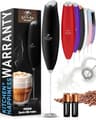
Zulay Handheld Milk Frother

Zulay Handheld Milk Frother

A battery handheld whisk that froths milk, matcha and hot chocolate in seconds. About the cheapest coffee gadget there is, and endlessly useful — the definitive tiny coffee gift.

Best for almost everyone
$9.89 · View on Amazon

$16.9942% off

Price as of October 5, 2026. #ad How we’re funded

2
Nespresso Aeroccino 3 Milk Frother

Nespresso Aeroccino 3 Milk Frother

A one-button electric jug that makes hot or cold froth automatically — pour milk in, press once, done. The easiest way to give someone cafe milk drinks at home.

Best hands-off option
$49.99 · View on Amazon

Price as of October 5, 2026. #ad How we’re funded

3
Breville Milk Café Frother

Breville Milk Café Frother

A large-capacity electric frother with real temperature control and a big jug — the premium standalone frother for a household that makes a lot of milk drinks.

Best for a household
$190.00 · View on Amazon

$199.955% off

Price as of October 5, 2026. #ad How we’re funded

The picks in full

#1Best for almost everyone

Zulay Handheld Milk Frother

A battery handheld whisk that froths milk, matcha and hot chocolate in seconds. About the cheapest coffee gadget there is, and endlessly useful — the definitive tiny coffee gift.

Great gift for: The perfect cheap-but-loved gift or stocking stuffer — everyone finds a use for it.

What’s good

  • Costs next to nothing
  • Froths milk, matcha, hot chocolate, protein shakes
  • No counter space needed

Worth knowing

  • Makes microfoam, not steamed-milk latte art
  • Skip it as a standalone 'main' gift — it's a lovely add-on, not a centerpiece
TypeHandheld battery whisk
Best forQuick froth, matcha, cocoa
PowerBattery

Specs read from the product listing, on July 25, 2026. Prices are pulled live and dated on the button.

#2Best hands-off option

Nespresso Aeroccino 3 Milk Frother

A one-button electric jug that makes hot or cold froth automatically — pour milk in, press once, done. The easiest way to give someone cafe milk drinks at home.

Great gift for: For the latte or cappuccino lover who wants foam without any technique — pure one-button convenience.

What’s good

  • Fully automatic hot or cold froth
  • Genuinely one-button simple
  • Consistent results every time

Worth knowing

  • Fixed batch size — not for making many drinks fast
  • Skip it if they want to learn latte-art steaming — that needs a steam wand
TypeElectric automatic jug frother
ModesHot + cold froth
Skill levelOne button

Specs read from the product listing, on July 25, 2026. Prices are pulled live and dated on the button.

#3Best for a household

Breville Milk Café Frother

A large-capacity electric frother with real temperature control and a big jug — the premium standalone frother for a household that makes a lot of milk drinks.

Great gift for: For a family or couple who make lattes and hot chocolate often and want a bigger, nicer frother.

What’s good

  • Large jug and adjustable temperature
  • Handles hot chocolate and latte milk well
  • Sturdier and more capable than a handheld

Worth knowing

  • Bulky and pricier than a jug frother
  • Skip it if one or two drinks a day is all they make
TypeElectric jug frother, temp control
ModesHot + cold, latte + cappuccino
CapacityLarge jug

Specs read from the product listing, on July 25, 2026. Prices are pulled live and dated on the button.

If you are buying this as a gift

A frother is one of the best-value coffee gifts there is, for a specific reason: it upgrades a drink someone already makes without replacing any equipment they already own. Someone with a drip machine and a $15 handheld whisk can make a latte. Someone with a drip machine and no frother cannot. That is a real change for very little money, and it needs no counter space, no learning and no explanation.

Two things to get right. First, match it to their drink: a handheld whisk is perfect for someone who wants cafe-style milk occasionally, and frustrating for someone making three lattes a day — they want a jug that runs while they do something else. Second, pair it with coffee strong enough to stand up to milk. A mug of filter coffee with foam on it tastes like milky coffee; a small, strong base is what makes it taste like a cafe drink. A moka pot plus a frother is the cheapest real latte setup that exists — see how to use a moka pot — and best espresso beans is the bag to put in the box alongside it.

Frequently asked questions

How do you froth milk without a frother?

The quickest reliable method is the jar shake: half-fill a jar with cold milk, seal it, shake hard for 30 to 45 seconds, then remove the lid and microwave it for about 30 seconds. The best texture comes from a French press — pour warm milk in no more than a third of the way up and pump the plunger quickly for 30 to 60 seconds. A balloon whisk and a back-and-forth pour between a pan and a jug also work, with less foam.

Can you froth milk in a French press?

Yes, and it produces the finest foam of any no-equipment method — the mesh forces air into the milk in small bubbles rather than large ones, which is what microfoam means. Use warm milk, fill the press no more than a third full because the milk roughly doubles in volume, and pump the plunger fast for 30 to 60 seconds. Rinse the press straight away with cold water; hot water sets milk protein onto the mesh.

Should you heat the milk before or after frothing?

Froth cold, then heat — for every method except heating in a pan. Cold milk holds bubbles better because the proteins are more stable, and heating gently afterwards keeps the foam intact. The one hard rule: never shake hot milk in a sealed container. Hot liquid builds pressure in a closed jar and the lid can come off unpredictably.

What milk froths the best?

Whole dairy milk, because it has enough protein to build structure and enough fat to make the foam rich and stable. Skim froths faster into a larger, drier foam that collapses sooner. Among non-dairy options, oat milk — especially anything labelled barista, which has added protein or stabiliser for exactly this purpose — is the best performer, soy is workable, almond is difficult and coconut generally will not foam usefully.

How hot should milk be for a latte?

Steaming but nowhere near boiling. The practical test without a thermometer is that you can still briefly hold a hand against the side of the jug. Boiling changes the taste and scalds the proteins so the foam will not hold at all. If you are heating in a microwave, do it in short bursts and stop as soon as you see steam rather than bubbles.

Is a milk frother worth buying?

For anyone making milk drinks more than occasionally, yes, and a handheld whisk costs very little. What you are paying for is repeatability and not using your hands: a frother with temperature control stops at the right point every time, hot-and-cold modes handle iced drinks as well as lattes, and a jug-style frother runs while you do something else. The improvised methods all work; none of them work identically twice.

Can you froth milk for iced coffee?

Yes, and it is easier than hot foam because no heating is involved at all. Shake cold milk in a sealed jar, or run a handheld whisk through it for 20 to 30 seconds, and pour it over the iced coffee. For a thicker cold foam, use whole milk or a splash of cream and shake for longer. This is also the one case where a cheap handheld frother clearly beats every pan-based method.

Why won't my milk froth?

Usually one of three things. The milk is not cold enough at the start, or it has already been heated once. The container is too full, so there is no room for the milk to expand — it roughly doubles. Or it is a milk that does not foam well, which covers most almond and coconut milks and some non-barista oat milks. Change the milk before you change the technique; it is the most common cause.

Sources

  • Merriam-Webster — latte — Merriam-Webster defines a latte as "espresso mixed with hot or steamed milk : caffe latte", and also "a similar drink made with an ingredient (such as rooibos or chai) other than espresso" (accessed September 18, 2026)
  • Merriam-Webster — flat white — Merriam-Webster defines a flat white as "espresso coffee topped with a thin layer of steamed milk" (accessed August 18, 2026)
  • National Coffee Association — How to Brew Coffee — NCA consumer guidance on brewing methods: drip, pour-over, French press, espresso and cold brew (accessed July 25, 2026)
  • National Coffee Association — Espresso — NCA on espresso: high pressure forcing nearly boiling water through a fine grind ("like table salt"), a 1:2 ratio of dry coffee to brewed espresso, 20–30 seconds of contact, crema as "the velvety, golden-brown top layer", and a machine, scale and grinder as the equipment (accessed August 18, 2026)

Keep reading